Aldara
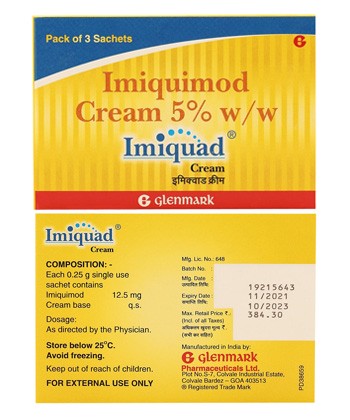
Aldara
- In our pharmacy, you can buy Aldara without a prescription, with delivery in the United Kingdom in discreet packaging. In most other markets it is prescription only (Rx), including the US and EU.
- Aldara is used to treat actinic keratosis, superficial basal cell carcinoma, and external genital/perianal warts. Its active substance is imiquimod, a topical immune response modifier that stimulates the local immune system to help the body fight abnormal skin cells and viral lesions.
- The usual dose depends on the condition: actinic keratosis is applied 2 times a week for about 16 weeks; superficial basal cell carcinoma 5 times a week for 6 weeks; and external genital/perianal warts 3 times a week for up to 16 weeks.
- Aldara is administered as a cream, usually in single-use sachets containing 5% imiquimod cream.
- It does not work immediately; local skin reactions and treatment response are usually seen over days to weeks, with noticeable benefit commonly appearing after several weeks of regular use.
- The duration of action depends on the indication and treatment course, ranging from 6 weeks for superficial basal cell carcinoma to up to 16 weeks for actinic keratosis and genital/perianal warts.
- There is no specific alcohol interaction known, but it is best to avoid excessive alcohol if it worsens skin irritation or if you feel unwell during treatment.
- The most common side effects are local skin reactions such as redness, irritation, itching, burning, dryness, pain, and rash at the application site; some people may also experience headache or fatigue.
- Would you like to try Aldara without a prescription?
Basic Aldara Information
- INN (International Nonproprietary Name): Imiquimod
- Brand names available in United Kingdom: Aldara 5% cream, generic imiquimod, Zyclara in some markets
- ATC Code: D06BB10
- Forms & dosages: Aldara 5% cream in 250 mg single-use sachets; Zyclara 3.75% and 2.5% in some markets; generic imiquimod in region-specific packs
- Manufacturers in United Kingdom: Original manufacturer was 3M Pharmaceuticals, now Meda, a Mylan/Viatris company; many generic suppliers now operate in Europe
- Registration status in United Kingdom: Prescription only in most markets
- OTC / Rx classification: Prescription only (Rx) in most markets, including the EU and other regulated regions
Latest UK And EU Research Highlights On Imiquimod
Could Aldara still be a sensible choice when a patient wants a non-surgical option?
Recent UK and EU evidence from 2022 to 2025 continues to support imiquimod as a topical immunomodulator with a defined place in dermatology and sexual health.
The clinical picture has not changed dramatically, but the practical message is clear.
It remains an MHRA/Rx treatment used mainly for actinic keratosis, superficial basal cell carcinoma and external genital/perianal warts.
The main strengths seen in practice are local effect, self-application and low systemic exposure.
That matters in UK prescribing because most concerns are about skin tolerance, not whole-body toxicity.
| Indication | Typical Response Seen In Studies | Common Adverse Effects | Discontinuation Patterns |
|---|---|---|---|
| Actinic keratosis | Clearance improves with the full course, but cure rates should not be overstated | Redness, irritation, burning, crusting | Some patients stop because of local inflammation |
| Superficial basal cell carcinoma | Useful for selected low-risk lesions when topical treatment is appropriate | Erythema, scabbing, erosions, pain | Stopping is usually linked to skin reactions or follow-up findings |
| External genital/perianal warts | Can reduce visible warts over a multi-week course | Local soreness, itching, swelling, flu-like symptoms in a minority | Discontinuation is often due to irritation or adherence issues |
Data highlight: systemic absorption is generally low, which is useful in UK prescribing because it supports local therapy with limited whole-body exposure, although extensive or broken skin can raise absorption.
For completeness, the INN is imiquimod, the ATC code is D06BB10, and Aldara 5% cream is commonly supplied in 250 mg single-use sachets.
Zyclara 2.5% and 3.75% also exist in some markets, but the UK conversation still centres on Aldara 5% cream and generic imiquimod.
Clinical Effectiveness In The UK NHS Context
Why do some patients prefer imiquimod over a procedure?
In NHS pathways, the appeal is usually the ability to treat at home rather than attend repeated clinic appointments.
That can matter when lesions are in awkward places, when privacy is important, or when a person wants to avoid surgery or cryotherapy.
Patient-reported benefits often include self-application, discretion and a sense of control.
The drawback is that the skin reaction can be quite obvious, and people sometimes stop too early because they think redness means harm rather than expected local inflammation.
Success in primary care and sexual health clinics depends heavily on the diagnosis being correct, the cream being applied properly and follow-up happening at the right time.
- Correct lesion type and location before treatment starts.
- Clear instructions on when to apply and when to wash off.
- Good adherence to the prescribed schedule.
- Patient understanding that redness and crusting can be expected.
- Review if the reaction becomes severe or the diagnosis is uncertain.
The condition-specific regimens matter in real life: actinic keratosis is commonly treated twice weekly for 16 weeks, superficial basal cell carcinoma five times weekly for 6 weeks, and external genital warts three times weekly for up to 16 weeks.
Those schedules are not interchangeable, so a pharmacist or prescriber should always check the indication before dispensing advice.
Indications And Expanded Uses Of Aldara
What is Aldara actually licensed for in the UK?
- Approved use
- Actinic keratosis, superficial basal cell carcinoma and external genital/perianal warts.
- Specialist or off-label use
- Other uses may be considered in selected specialist settings, but they should not be assumed routine in NHS or private care.
- Product context
- Aldara 5% cream sachets, generic imiquimod and Zyclara in some markets all sit within the same imiquimod family.
- Classification
- D06BB10 in dermatologicals, with prescription only status in the UK.
That distinction matters because patients often see “genital warts cream” or “cream for actinic keratosis UK” online and assume the same product fits every situation.
It does not.
The diagnosis, lesion burden and treatment site should guide the choice, especially where facial skin, perianal skin or a suspected skin cancer is involved.
Composition, Brand Landscape And Packaging In The UK
Why do sachets matter so much with this medicine?
Aldara’s active ingredient is imiquimod, and the UK-relevant formulation is usually 5% cream.
That cream is often supplied in single-use 250 mg sachets, which helps reduce contamination and makes dosing more controlled.
Original supply came through 3M Pharmaceuticals, later Meda and Mylan-Viatris, while many European markets now also have generic imiquimod.
| Product | Strength | Usual Pack Style |
|---|---|---|
| Aldara | 5% | Single-use sachets, commonly 250 mg |
| Zyclara | 3.75% | Pump bottle or sachets |
| Zyclara | 2.5% | Some markets only |
| Generic imiquimod | Region-specific | Sachets or tubes depending on supplier |
In UK pharmacy stock, branded or generic supply may vary with wholesaler availability.
That means a patient may receive Aldara, generic imiquimod or a different pack style, but the prescribed medicine should still be checked against the actual strength and instructions.
Contraindications, Cautions And High-Risk Groups
Who should not use it, and who needs extra care?
| Absolute Contraindications | Relative Precautions |
|---|---|
| Hypersensitivity or allergy to imiquimod or excipients such as isostearic acid, cetyl alcohol or parabens | Autoimmune disease or immunosuppression |
| Not specified | Inflammatory skin disease at the treatment site |
| Not specified | Extensive, open or ulcerated lesions because absorption may increase |
Pregnancy and breastfeeding need clinician review rather than casual self-selection.
Elderly patients usually do not need a formal dose change, and studies suggest good tolerability.
If the person has significant skin disease, immunosuppression or lesions that look ulcerated, specialist input is sensible.
There is no expected sedative effect, but flu-like symptoms can make someone feel unwell enough to affect daily comfort.
Dosage Guidelines And Regimen Practicalities
How is Aldara used without causing avoidable problems?
The cream should be applied as a thin layer to clean, dry skin and washed off after the prescribed interval.
| Indication | Frequency | Duration | Time Left On Skin |
|---|---|---|---|
| Actinic keratosis | 2 times a week | 16 weeks | About 8 hours |
| Superficial basal cell carcinoma | 5 times a week | 6 weeks | About 8 hours |
| External genital/perianal warts | 3 times a week | Up to 16 weeks | 6 to 10 hours |
Older adults do not usually need dose adjustment.
Children are only relevant for certain genital wart indications, and younger paediatric data are limited.
Liver or kidney impairment does not have a standard dose adjustment recommendation, but caution is still sensible because absorption is usually low yet can rise if extensive areas are treated.
A patient collecting treatment after work on a Friday evening may only need one sachet at a time, but the timing still needs to match the condition-specific plan.
Interactions, Missed Doses And Safety Reporting
Do people need to worry about food or drink with a topical medicine?
Food interactions are not a major issue because imiquimod is topical.
Patients often ask about alcohol, tea or coffee, and the practical concern is tolerance of local or systemic symptoms rather than true food-drug interaction.
If a dose is missed, it should be applied when remembered on the same day if appropriate.
If that is not possible, the dose should be skipped and never doubled up.
- Other irritant skin treatments applied to the same area.
- Marked local inflammation before starting or during treatment.
- Concurrent medicines or procedures that may further irritate the skin.
- Unexpected swelling, ulceration or spreading rash.
Unexpected adverse effects should be reported through the MHRA Yellow Card scheme.
That reporting route is especially useful when the reaction seems stronger than expected or does not settle in the usual way.
Cultural Perceptions And Patient Habits In The UK
Where do people usually look first when they are worried about Aldara?
A lot of patients check NHS patient portals, Patient.info, Mumsnet or sexual health forums before they speak to a GP or pharmacist.
That is understandable, especially when the problem is genital warts or a visible facial lesion.
- Many people want discreet treatment and avoid in-person procedures.
- Redness, crusting and soreness can feel alarming even when expected.
- Some patients expect results too quickly and stop before the course is complete.
- Pharmacist counselling is often the turning point in England, Scotland, Wales and Northern Ireland.
- NHS 111 and online symptom-checkers can help with triage, but they do not replace diagnosis.
That mix of privacy, anxiety and self-management is exactly why imiquimod discussions are so common in UK community pharmacy.
People usually want a clear answer, a safe plan and reassurance that local reactions do not automatically mean treatment failure.
Availability, Access And Pricing Patterns Across The UK
How do people usually get Aldara in the UK?
The main routes are an NHS prescription, a private prescription or a reputable online pharmacy using an electronic prescription.
Large chains such as Boots, LloydsPharmacy and Superdrug may stock it, but availability depends on region and wholesaler supply.
| Access Route | Typical Cost Pressure | Who Usually Pays |
|---|---|---|
| NHS prescription | Lower direct cost where prescription charging applies | NHS or patient depending on country and exemption status |
| Private prescription | Usually higher overall cost | Patient |
| Online pharmacy with electronic prescription | Varies by service and dispensing model | Patient or prescriber pathway |
| Pharmacy chain dispensing | Depends on prescription route and local charges | Patient or NHS system |
England has prescription charges, while Scotland, Wales and Northern Ireland generally operate free prescriptions under their own systems.
Private purchase is usually more expensive than NHS supply.
In our online pharmacy, aldara is available without a prescription, with discreet delivery to United Kingdom in 5-14 days.
That can be useful for people who already understand the medicine and need a convenient fulfilment route, but the diagnosis still needs to be right.
Comparable Medicines And Treatment Preferences
What if Aldara is not the best fit?
The right option depends on lesion type, location, patient preference and whether home treatment or a procedure is more suitable.
| Option | Pros | Cons |
|---|---|---|
| Podofilox | Self-applied option for genital warts | Local irritation and not suitable for every patient |
| Sinecatechins | Another self-applied wart treatment | Can still irritate the skin and needs regular use |
| Cryotherapy | Quick in-clinic treatment | Requires appointments and may be painful |
| 5-Fluorouracil creams | Used for actinic keratosis | Local reactions and not for every lesion |
| Diclofenac gel | Another actinic keratosis option | Usually slower and still needs consistent use |
| Photodynamic therapy | Useful for selected actinic keratosis cases | Procedure-based and clinic-dependent |
| Surgical excision | Definitive for some basal cell carcinomas | Invasive and not always needed |
| Curettage | Can be effective for selected lesions | Procedure-based and lesion-dependent |
| Mohs surgery | Tissue-sparing approach for suitable skin cancers | Specialist procedure, not a first-line home treatment |
Some patients value privacy and home use, while others want faster in-clinic treatment and a clear endpoint.
Neither preference is wrong.
Faq For UK Patients
- How long does Aldara take to work?
- It varies by condition, and the full regimen may run for weeks to months.
- Can I use it on broken skin?
- It should not be used on broken skin, and it must be kept away from eyes, nostrils, mouth, vagina and rectum.
- Is it available on the NHS?
- It may be prescribed within NHS pathways when clinically appropriate, but access depends on the condition and local prescribing decisions.
- What should I do if I get a strong skin reaction?
- Stop and seek review if the reaction is severe, spreading or worrying.
UK Pharmacist Counselling And Proper-Use Guidance
What would a pharmacist normally check before someone starts Aldara?
- Confirm the indication and the exact strength supplied.
- Apply a thin layer only to the affected area.
- Avoid mucosal surfaces and do not use on eyes, nostrils, mouth, vagina or rectum.
- Wash hands before and after application.
- Do not cover the area unless specifically instructed.
- Wash the cream off after the prescribed time.
- Store at room temperature, between 15 and 25°C, and keep it away from heat, freezing and light.
Single-use sachets help reduce contamination risk and make dosing errors less likely.
That is one reason they remain the most practical format for many UK patients.
If the skin reaction becomes difficult to tolerate, the next step is usually pharmacy advice, GP review, sexual health clinic follow-up or a check through NHS digital resources.
Delivery Across United Kingdom
| City | Region | Delivery Time |
|---|---|---|
| London | England | 5-7 days |
| Birmingham | England | 5-7 days |
| Manchester | England | 5-7 days |
| Liverpool | England | 5-7 days |
| Leeds | England | 5-7 days |
| Sheffield | England | 5-7 days |
| Bristol | England | 5-7 days |
| Newcastle upon Tyne | England | 5-7 days |
| Nottingham | England | 5-7 days |
| Cardiff | Wales | 5-7 days |
| Edinburgh | Scotland | 5-7 days |
| Glasgow | Scotland | 5-7 days |
| Belfast | Northern Ireland | 5-7 days |
| Aberdeen | Scotland | 5-9 days |
| Exeter | England | 5-9 days |