Isotretinoin
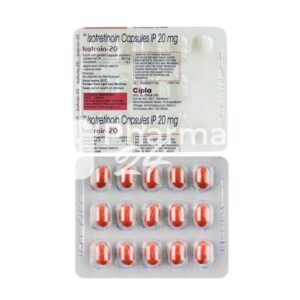
In brief
- Isotretinoin is a prescription-only medicine in the UK, EU, USA and most other countries because it can cause severe birth defects and other serious adverse effects. In normal legal supply it is dispensed under strict controls, although some online pharmacies may claim to offer it without a prescription.
- Isotretinoin is used to treat severe recalcitrant nodular or cystic acne that has not improved with other treatments. It is a systemic retinoid that works by reducing sebum production, shrinking oil glands, lowering inflammation, and helping prevent blocked pores.
- The usual starting dose is 0.5 mg/kg/day, which may be increased to up to 1 mg/kg/day depending on response and tolerability. Treatment commonly continues for 16–24 weeks, or until a cumulative dose of about 120–150 mg/kg is reached.
- It is usually taken by mouth as hard capsules, soft capsules, or, more rarely, an oral suspension.
- It does not work immediately; improvement is usually seen after several weeks, often around 2–4 weeks, with clearer benefit developing over 1–2 months.
- The course of action lasts for the full treatment period, typically 16–24 weeks, and in some people the benefits may persist for months after treatment ends. A repeat course may be needed if acne returns.
- Alcohol should be avoided or kept to a minimum, as it can increase the risk of raised liver enzymes and high triglycerides while taking isotretinoin.
- The most common side effects are dry lips, dry skin, dry eyes, nosebleeds, and peeling skin; muscle or joint aches, headache, and raised blood fats can also occur.
- Would you like to try isotretinoin without a prescription?
Basic Isotretinoin Information
- INN (International Nonproprietary Name): Isotretinoin
- Brand names available in United Kingdom: Roaccutane, Roacutan
- ATC Code: D10BA01
- Forms & dosages: Hard capsules/tablets in 5 mg, 10 mg, 20 mg and 40 mg strengths; soft capsules in some markets; oral suspension is rare
- Manufacturers in United Kingdom: Roche and other global manufacturers and distributors including Ranbaxy (Sun Pharma), Mylan, Mepha Pharma, Sandoz, Eurogenerics, Pierre Fabre, Valeant, Stiefel, Aurobindo, Amneal and Cipla
- Registration status in United Kingdom: Prescription only
- OTC / Rx classification: Prescription only in all jurisdictions due to severe side effects, including teratogenicity
Latest Research Findings On Isotretinoin
What does the newer evidence actually say about isotretinoin, and should patients still think of it as the strongest acne tablet available?
Recent UK and EU data from 2022 to 2025 continue to support high effectiveness in severe acne, with relapse still seen in a minority of patients after a standard course.
Most studies still describe the usual treatment window as 16 to 24 weeks, with doses commonly starting at 0.5 mg/kg/day and increasing towards 1 mg/kg/day as tolerated.
Mucocutaneous effects remain the most consistent adverse reactions, especially dry lips, dry skin and dry eyes, while raised triglycerides and mild liver enzyme changes are monitored through routine blood testing.
Reports from pharmacovigilance systems also keep the psychiatric safety debate alive, but the quality of evidence varies widely between randomised trials, observational cohorts and Yellow Card reports.
That matters in clinic, because a trial can show how well isotretinoin clears acne, while a spontaneous report may highlight a possible safety signal without proving cause and effect.
| Study type | Main finding | Clinical meaning |
|---|---|---|
| Randomised trials | Strong acne clearance and lower relapse after a full course | Best evidence for efficacy |
| Observational cohorts | Useful real-world data on dry skin, lip dryness, lipid changes and retreatment after relapse | Best for everyday tolerability patterns |
| Yellow Card reports | Signal detection for rare or serious adverse reactions, including mood-related concerns | Helpful for safety monitoring, not proof of causation |
Data highlights: oral isotretinoin is ATC D10BA01, remains prescription only in the UK and EU, and is typically used for 16 to 24 weeks at 0.5 to 1 mg/kg/day.
Data highlights: the main routine safety checks focus on lipids, liver enzymes and pregnancy prevention, with MHRA-aligned controls in UK prescribing because of the drug’s severe teratogenic risk.
Data highlights: evidence quality is highest for acne clearance, moderate for common side effects, and less certain for psychiatric signals because reports come from mixed-quality sources.
Clinical Effectiveness In NHS And Private UK Care
Who tends to do best on isotretinoin, and what can patients realistically expect once treatment starts?
The clearest responders are people with severe recalcitrant nodular or cystic acne that has not settled with topical treatment or antibiotics.
That is the standard indication used across UK and EU practice, and it is why this medicine is usually reserved for more stubborn disease rather than routine breakouts.
In NHS care, many patients see a marked reduction in inflamed lesions, less new scarring and a better day-to-day quality of life over the course of treatment.
Tolerability still matters, because dry lips, dry skin and dry eyes are common and can be annoying enough to affect adherence if they are not discussed early.
Some patients need a second course, usually after a gap of around two months if relapse occurs.
That is particularly relevant when the first course improved acne a lot but did not fully keep it away long term.
Data highlights: the usual Roaccutane course is long enough to give sustained benefit for many people, but relapse can still happen and retreatment is sometimes needed.
Data highlights: in both NHS and private care, the most visible improvements are fewer painful lesions, less oiliness and less scarring risk.
Data highlights: private follow-up is often more direct and frequent, while NHS care usually runs through GP referral, dermatology review and shared-care arrangements.
- Better acne clearance after topical treatment has failed.
- Less inflammation and less risk of permanent scarring.
- Improved confidence and social comfort for many patients.
- Dry lips, dry skin and dry eyes are the most common day-to-day drawbacks.
- Some people need a repeat course after relapse.
Indications, Approved Use And Off-Label Practice
Is isotretinoin just a stronger spot treatment?
No, and that is a common misunderstanding.
It is a systemic retinoid for acne, not a general cream or a quick fix for an occasional pimple.
The MHRA-approved core use is severe acne unresponsive to conventional therapy, especially severe recalcitrant nodular or cystic acne.
Topical products with similar names are not the same medicine, and they do not work in the same way.
In UK dermatology practice, some specialist clinics may consider off-label uses, but that should always be clinician-led and evidence-based.
The medicine is approved for people over 12 years, and dosing is weight-based.
- Off-label
- Use outside the main licensed indication or patient group.
- Systemic retinoid
- A vitamin A-related medicine taken by mouth that works throughout the body.
- Cumulative dose
- The total amount taken over the whole course, often used to plan treatment length.
| Use | Typical setting | Comment |
|---|---|---|
| Severe acne unresponsive to conventional therapy | Approved use | Main MHRA-aligned indication |
| Specialist off-label use | Selected dermatology or private clinic cases | Should remain clinician-led |
Composition, Formulations And Brand Landscape
Why do some packs say Roaccutane while others just say isotretinoin?
The INN is isotretinoin, but the UK and EU brand landscape has varied over time, with Roaccutane and Roacutan being the best-known historical names.
Patients may also see generic packs or locally supplied branded versions depending on the pharmacy, supplier and import route.
In day-to-day UK dispensing, the most common presentation is hard capsules in 5 mg, 10 mg, 20 mg and 40 mg strengths.
Soft capsules exist in some markets, while oral suspension is rare and is mainly associated with the US.
That is why the box on a Friday evening order can look different from one collected through a high street pharmacy the week before.
| Brand or Form | Region | Packaging | Strengths |
|---|---|---|---|
| Roaccutane / Roacutan | UK, EU, Latin America | Blister packs | 5 mg, 10 mg, 20 mg, 40 mg |
| Curacné / Curacne / Curakne | France, EU | Blister packs | Varies |
| Isotretinoin-Mepha | Switzerland | Packs | 10 mg, 20 mg, 40 mg |
| Generic isotretinoin | United Kingdom | Blister packs | 5 mg, 10 mg, 20 mg, 40 mg |
Data highlight: hard capsules and tablets in 5 mg, 10 mg, 20 mg and 40 mg strengths are the most common UK-facing forms.
Contraindications, High-Risk Groups And Everyday Precautions
Before anyone starts isotretinoin, what makes it unsafe or unsuitable?
There are several absolute contraindications that need to be checked carefully.
Pregnancy or planning pregnancy is the most important one because the drug is highly teratogenic.
Breastfeeding is also a no.
Severe hepatic or renal impairment, hypervitaminosis A, very high blood lipid values and known hypersensitivity to isotretinoin or excipients are also listed as absolute contraindications.
Some people can still use it, but only with caution and monitoring.
That includes people with a history of depression or psychiatric illness, diabetes, lipid disorders, chronic alcohol use and children under 12 years.
Dry eyes can make contact lens wear uncomfortable, reduced night vision matters for driving, and photosensitivity means sun protection is worth taking seriously.
- Do not use during pregnancy.
- Do not use while breastfeeding.
- Tell the prescriber about liver, kidney, mood or lipid problems.
- Use sun protection because the skin can become more sensitive.
- Be careful with contact lenses if the eyes become dry.
- Avoid driving if night vision seems reduced.
- Alcohol advice is usually personalised because liver and lipid risk varies.
Dosage Guidelines And Monitoring Schedules
How much is usually prescribed, and what happens during follow-up?
Standard UK dosing often starts at about 0.5 mg/kg/day and can be increased to 1 mg/kg/day depending on response and tolerability.
The usual course lasts 16 to 24 weeks, or until a cumulative dose of 120 to 150 mg/kg has been reached.
In adolescents over 12 years, dosing is still weight-based and should be adjusted with tolerability in mind.
If there is severe hepatic or renal impairment, lower starting doses or avoidance may be needed.
Missed doses should be taken as soon as remembered unless the next dose is close, and double-dosing should be avoided.
Overdose is rare, but it can cause vitamin A toxicity and needs urgent medical attention.
| Item | Usual approach | Monitoring point |
|---|---|---|
| Starting dose | 0.5 mg/kg/day | Assess tolerability |
| Titration | Up to 1 mg/kg/day | Check response and side effects |
| Duration | 16 to 24 weeks | Consider cumulative dose target |
| Blood tests | Lipids and liver enzymes | Baseline and follow-up |
| Pregnancy prevention | Strict controls where relevant | Before, during and after treatment |
Interaction Overview: Medicines, Food, Drink And Supplements
Can patients still take vitamins, antibiotics or a drink at the weekend?
That is one of the most common pharmacy questions.
Because isotretinoin is a retinoid, it should not be combined with vitamin A supplements or other vitamin A-rich products.
Alcohol is also worth discussing, as it can add to liver and triglyceride concerns.
Tetracyclines should generally be avoided because of the risk of intracranial hypertension.
Tea and coffee are not major pharmacological interactions, although some people notice stomach sensitivity and prefer to take medicines in a routine that suits them.
Any suspected side effect can be reported in the UK through the MHRA Yellow Card system.
| Interaction type | Risk | Counselling point |
|---|---|---|
| Vitamin A supplements | Extra toxicity risk | Avoid unless specifically advised |
| Tetracyclines | Intracranial hypertension risk | Generally avoid together |
| Alcohol | May worsen liver and triglyceride issues | Discuss sensible limits individually |
| Tea and coffee | No major pharmacological interaction | Usually fine |
Cultural Perceptions And Patient Habits In The United Kingdom
Why does isotretinoin feel like such a big step for so many people in the UK?
A lot of patients first hear about it on NHS forums, Patient.info, Mumsnet, TikTok or from a friend who has already been through a course.
That can make it sound like the “last resort” acne medicine, which is partly true but can also make people anxious before they even start.
Pharmacist counselling matters a lot here, especially when a patient collects from Boots, LloydsPharmacy, Superdrug or an online pharmacy.
NHS 111 advice, patient portals and digital repeat-prescription systems also help keep people on track with blood tests, contraception checks and follow-up appointments.
The most common questions are simple and practical: is it safe, will it dry my skin, can I drink alcohol, and will it affect my mood?
Those questions deserve clear answers, not jargon.
- “Is it safe?”
- “Will it dry my skin and lips?”
- “Can I drink alcohol?”
- “Will it affect my mood?”
- “How long will the course last?”
Data highlight: the best counselling touchpoints are the prescriber, the community pharmacist, the follow-up clinic and the digital portal that reminds patients about tests and contraception checks.
Availability, NHS Pricing And Regional Access Patterns
Is isotretinoin easy to get in the UK, and does it cost the same everywhere?
In the UK it is prescription only, and patients usually access it through GP referral to dermatology or through a private prescriber.
NHS and private routes both exist, but the follow-up structure is different.
NHS care usually involves referral, specialist review and shared-care arrangements.
Private care often offers faster access and more frequent review, although the clinical standards on safety still need to be high.
Across England, Scotland, Wales and Northern Ireland, prescription charges and exemption rules differ, so the final cost can vary.
Patients may collect from Boots, LloydsPharmacy, Superdrug or use an online pharmacy with electronic prescribing and nomination systems.
In our online pharmacy, isotretinoin is available without a prescription, with discreet delivery to United Kingdom in 5 to 14 days.
| Access route | Typical pathway | Practical point |
|---|---|---|
| NHS | GP referral to dermatology | Possible prescription charge rules vary by UK nation |
| Private clinic | Specialist assessment and follow-up | Often faster access |
| Online pharmacy | E-prescription and home delivery | Useful for repeat dispensing and convenience |
Comparable Acne Medicines And Why Isotretinoin Is Chosen
Why choose isotretinoin instead of doxycycline, creams or hormonal treatment?
Because it is usually stronger for severe or scarring acne and can address several acne pathways at once.
That is why it is often chosen when topical retinoids, benzoyl peroxide, azelaic acid, clindamycin gels, dapsone or tetracyclines have not been enough.
Hormonal options may suit some patients, especially when acne seems linked with hormonal patterns, but they are not a substitute for isotretinoin in severe nodular disease.
The trade-off is simple.
Isotretinoin offers stronger clearance, but it brings more intensive monitoring and strict teratogenicity controls.
| Treatment | Typical role | Main limitation |
|---|---|---|
| Doxycycline or minocycline | Moderate inflammatory acne | Not usually enough for severe scarring acne |
| Topical retinoids | Mild to moderate acne | Less powerful than oral isotretinoin |
| Benzoyl peroxide and azelaic acid | Topical first-line care | May not clear nodular disease |
| Hormonal treatment | Selected patients | Not suitable for everyone |
| Isotretinoin | Severe recalcitrant acne | Requires monitoring and pregnancy controls |
Frequently Asked Questions About Isotretinoin
How long does isotretinoin take to work?
Many people start to notice improvement during the course, but the usual treatment length is 16 to 24 weeks.
Can I drink alcohol?
Often this is a personalised discussion, because alcohol can affect liver and triglyceride risk.
Why do I need blood tests?
Blood tests help check lipids and liver enzymes, which can change during treatment.
What if I miss a dose?
Take it as soon as you remember unless the next dose is close, and never double-dose.
What if I take too much?
Overdose is rare, but it can cause vitamin A toxicity and needs urgent medical attention.
Proper Use, Pharmacist Counselling And NHS Support
What should patients actually do day to day once the capsules are prescribed?
Take isotretinoin exactly as directed, and follow food instructions if the label or pharmacist gives them.
Store the capsules at 15 to 25°C, in the original packaging, away from heat and moisture.
Pregnancy prevention rules must be followed carefully, and anyone who may be pregnant should seek advice immediately.
Help should also be sought promptly for mood changes, severe headache, visual symptoms or any sign of pregnancy.
NHS counselling is usually clear, calm and non-judgemental, with an emphasis on adherence, side-effect management and safety-netting.
NHS patient portals, GP practice messaging, dermatology leaflets and Yellow Card reporting all support that process.
- Safety-netting
- Giving clear advice on what symptoms need urgent review.
- Adherence
- Taking the medicine exactly as prescribed.
- Pharmacovigilance
- Monitoring and reporting suspected side effects after a medicine is used.
- Take capsules exactly as prescribed.
- Keep the pack in the original container at 15 to 25°C.
- Do not use in pregnancy or while breastfeeding.
- Attend blood tests and follow-up appointments.
- Report mood, headache, eye or vision changes quickly.
- Use Yellow Card reporting if a suspected adverse reaction needs to be logged.
Delivery Across United Kingdom
| City | Region | Delivery time |
|---|---|---|
| London | England | 5-7 days |
| Birmingham | England | 5-7 days |
| Manchester | England | 5-7 days |
| Leeds | England | 5-7 days |
| Glasgow | Scotland | 5-7 days |
| Edinburgh | Scotland | 5-7 days |
| Liverpool | England | 5-7 days |
| Bristol | England | 5-7 days |
| Cardiff | Wales | 5-7 days |
| Belfast | Northern Ireland | 5-7 days |
| Sheffield | England | 5-9 days |
| Nottingham | England | 5-9 days |
| Leicester | England | 5-9 days |
| Coventry | England | 5-9 days |
| Aberdeen | Scotland | 5-9 days |