Hydroquinone
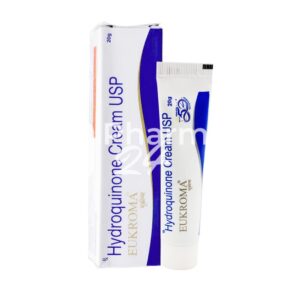
In brief
- Hydroquinone can be purchased in some pharmacies and online stores without a prescription in certain countries, especially lower-strength 2% products; however, in many regulated markets stronger 4% and above formulations are prescription-only. Availability and rules vary by region, so local pharmacy laws should always be checked.
- Hydroquinone is used for the treatment of melasma, hyperpigmentation, lentigines and post-inflammatory dark marks. It works by inhibiting tyrosinase, an enzyme involved in melanin synthesis, thereby helping to lighten darkened areas of skin.
- The usual dose is a thin layer of 2%–4% cream applied once or twice daily to the affected skin. Treatment is typically limited to a few months and should be reviewed regularly.
- The form of administration is topical cream, with gel, lotion, and combination depigmenting creams also available in some regions.
- The effect usually begins gradually within 2–4 weeks, although visible skin-lightening improvement may take longer depending on the condition being treated.
- The duration of action is ongoing with regular use, but treatment courses are generally limited to about 2–4 months, and not usually longer than 4–6 months without medical supervision.
- Alcohol does not have a direct known interaction with topical hydroquinone, but it may worsen skin irritation in some people. Avoid applying it on irritated or inflamed skin and use sun protection regularly.
- The most common side effects are redness, mild burning or stinging, dryness, peeling, and temporary skin lightening; less commonly, allergic contact dermatitis or irritant dermatitis may occur.
- Would you like to try hydroquinone without a prescription?
Latest Research Findings: UK, EU And Safety Signals For Hydroquinone
- INN (International Nonproprietary Name): Hydroquinone
- Brand names available in United Kingdom: Not specified
- ATC Code: D11AX11
- Forms & dosages: Cream 2%, 4%, 5%; gel 2%, 4%; lotion 2%, 4%; combination products with tretinoin, corticosteroids and sunscreen
- Manufacturers in United Kingdom: Not specified
- Registration status in United Kingdom: Prescription pathways and local governance apply; routine OTC purchase is not standard
- OTC / Rx classification: Rx in most regulated markets for 2% to 4% and higher strengths; ≤2% may be OTC in some regions
Hydroquinone remains a familiar name in dermatology because it is a phenol derivative used for topical depigmentation, with ATC code D11AX11.
That matters because regulated markets now treat it cautiously, not as a casual beauty product.
Recent work from 2022 to 2025 continues to focus on melasma management, post-inflammatory hyperpigmentation and the role of combination therapy rather than hydroquinone alone.
In practice, hydroquinone is still considered a targeted treatment, not a routine skin-brightening cream.
UK access depends on prescription pathways, clinical review and local governance, which is why it is not a standard over-the-counter purchase in most settings.
Across Europe, including markets tracked by ANMDMR, approvals, warnings and withdrawals are published online and may change.
That regulatory caution is linked to irritation, the risk of exogenous ochronosis with long-term use, and broader hazard classifications that keep prescribers alert.
For patients, the practical message is simple: use it for a defined reason, for a defined time, and with sun protection.
| Evidence theme | Main finding | Practical implication |
|---|---|---|
| Melasma | Hydroquinone remains useful, especially in combination regimens | Expect specialist-led treatment rather than self-directed long-term use |
| Post-inflammatory hyperpigmentation | Improvement is usually gradual and variable | Adherence and review matter more than strength alone |
| Safety | Irritation and ochronosis remain the main concerns | Limit duration and stop if the skin becomes inflamed |
| Regulation | Prescription controls are common in regulated markets | Access in the UK is governed by prescription and local policy |
Data highlight: Long-term use should be limited, sunscreen co-use is essential, and broken or irritated skin should be avoided because it increases the risk of side effects.
Clinical Effectiveness In The United Kingdom: What Patients Can Realistically Expect
Most people ask the same question first: how much fading should be expected, and how quickly?
Hydroquinone is used in practice for melasma, lentigines or age spots, and post-inflammatory hyperpigmentation.
The realistic answer is gradual improvement rather than instant lightening.
Patients often want a natural-looking reduction in contrast, not “skin bleaching”, and that is exactly how treatment should be framed.
Response depends on skin tone, the cause of the pigmentation, and how carefully sun protection is followed.
If there is no benefit after a set treatment period, review is needed rather than simply continuing.
| Indication | Typical strength | Frequency | Expected timeframe |
|---|---|---|---|
| Melasma | 2% to 4% cream | 1 to 2 times daily | 2 to 4 months |
| Lentigines / age spots | 2% to 4% cream | Once daily | Up to 3 months |
| Post-inflammatory hyperpigmentation | 2% to 4% cream | 1 to 2 times daily | 2 to 6 months with reassessment |
Data highlight: SPF 30+ should be used throughout treatment, and hydroquinone should not be applied to broken skin because irritation can worsen pigmentation.
Indications And Expanded Uses: MHRA Context And Off-Label Practice
Is hydroquinone a cosmetic brightener or a medicine?
It is a medicine, and it should be used that way.
The main dermatology indications are melasma, PIH and lentigines.
In the UK, prescribing often happens in specialist or private settings, with local formularies and MHRA-aligned governance shaping what is used and how.
Some regions use triple combination creams for refractory melasma, particularly where prescribing is more common.
Patients may see names such as Obagi Nu-Derm, Eldoquin or Melalite online, but that does not guarantee UK availability or a straightforward legal route.
Depending on the product and route, use may be off-label, so supervision is important.
- Melasma
- Patchy facial pigmentation, often persistent and triggered or worsened by sunlight.
- PIH
- Dark marks left behind after inflammation such as acne or eczema.
- Lentigines
- Flat brown spots, often called age spots.
Hydroquinone is usually prescribed short term and then reviewed rather than continued indefinitely.
Data highlight: Treatment should be time-limited and reassessed, especially where a combination cream is being used.
Composition And Brand Landscape: What Hydroquinone Looks Like Across Markets
What does hydroquinone actually come as?
In global markets, it is most often seen as cream, with gel and lotion also available.
Strengths commonly include 2%, 4% and 5%, and packaging often ranges from 15 g to 60 g tubes.
Brand familiarity on social media does not equal UK supply, so a product well known in India, the Middle East or Eastern Europe may not be stocked here.
Combination products with tretinoin, corticosteroids and sunscreen are also used in some markets.
| Strength | Form | Common use | Market notes |
|---|---|---|---|
| 2% | Cream, gel or lotion | Milder hyperpigmentation | May be OTC in some regions |
| 4% | Cream | Most common prescription strength | Frequently discussed in UK and online searches |
| 5% | Cream | Specialist use in some markets | More closely controlled |
| Combination | Various | Refractory melasma | May include tretinoin and corticosteroids |
Manufacturers named in international markets include Terapia, Zentiva, Cantabria Labs, Abbott and Wallace Pharma.
Data highlight: ANMDMR is the key public database for Romanian and some Eastern European checks, but it does not determine UK status.
Contraindications And Special Precautions: Who Should Avoid It
Which patients should be cautious before using hydroquinone?
The biggest safety issue is simple: do not apply it to skin that is already inflamed.
Allergy, eczema, broken skin and recent sunburn are clear reasons to avoid treatment on that area.
Pregnancy and breastfeeding need specialist advice because controlled safety data are lacking.
Extra care is sensible in psoriasis, atopic dermatitis, previous reactions to phenols or resorcinol, and vitiligo, where depigmentation may worsen.
- Do not use if there is known hypersensitivity to hydroquinone or excipients.
- Do not use on broken, irritated or sunburnt skin.
- Seek specialist advice in pregnancy or breastfeeding.
- Use caution if you have psoriasis, atopic dermatitis or vitiligo.
- Discuss first if you have reacted to phenols or resorcinol before.
People often assume a lightening cream is automatically gentle, but prescription dermatology products deserve the same respect as any other medicine.
Data highlight: Do not use on irritated skin, because that is where redness, stinging and dermatitis are most likely to begin.
Dosage Guidelines: NHS-Style Practical Use And Treatment Limits
How should hydroquinone be used day to day?
The general rule is a thin layer on cleansed affected skin, then review after a short treatment period.
For melasma and hyperpigmentation, the usual regimen is 1 to 2 times daily.
For lentigines or age spots, once daily is the usual pattern.
Long-term use is not advised because ochronosis risk rises when people keep applying it for too long.
| Indication | Typical strength | Frequency | Duration |
|---|---|---|---|
| Melasma / hyperpigmentation | 2% to 4% cream | 1 to 2 times daily | 2 to 4 months, then review |
| Lentigines / age spots | 2% to 4% cream | Once daily | Up to 3 months |
| Post-inflammatory hyperpigmentation | 2% to 4% cream | 1 to 2 times daily | 2 to 6 months, with reassessment |
- Wash and dry the affected skin first.
- Apply a thin layer only to the pigmented area.
- Avoid the eyes, lips and mucous membranes.
- Do not apply to broken or irritated skin.
- Use SPF 30+ every day.
Children under 12 do not have established safety or efficacy data, so specialist advice is needed.
No specific elderly dose change is listed, although the skin may be more sensitive.
Data highlight: Review is needed after 2 to 4 months for most uses, and sun protection is part of the treatment, not an optional extra.
Interactions Overview: What Matters In Day-To-Day Use
Can hydroquinone clash with the rest of a skincare routine?
Food and drink interactions are limited because this is a topical medicine.
The bigger issue is irritation from other products.
Strong acids, exfoliants, retinoids and corticosteroid combinations can either sting the skin or hide early warning signs.
- Discuss first if you are using retinoids or exfoliating acids.
- Avoid combining with harsh scrubs or aggressive cleansing routines.
- Be cautious if alcohol flushes your skin easily, because redness can be confused with irritation.
- Tea and coffee are not known to have a direct interaction, but anxiety about “triggers” is common.
For UK patients, reporting suspected problems through the MHRA Yellow Card scheme helps build trust and safety awareness.
Data highlight: If swallowed or used excessively on large areas, hydroquinone may cause serious toxicity such as methemoglobinaemia or acute dermatitis.
Cultural Perceptions And Patient Habits In The United Kingdom
Where do people in the UK usually hear about hydroquinone?
Often it is not through NHS advertising, but through dermatology forums, beauty communities, Patient.info, Mumsnet or private clinic conversations.
Many people ask for a skin lightening cream when what they really want is help with melasma, acne marks or sun damage.
That wording matters because pigmentation concerns are not just cosmetic for many patients, especially across diverse skin tones.
Pharmacist counselling at Boots, LloydsPharmacy and Superdrug has also shaped how patients think about topical treatments, while online pharmacies and electronic prescriptions have made private access more familiar.
- Hydroquinone
- The standard English name used in prescribing and pharmacy settings.
- Hydrochinon
- A spelling patients may see in some European contexts and online searches.
- Hydroquinona
- The Spanish and Portuguese term, often seen in international product listings.
Patients commonly want a clear routine, a visible but natural result, and reassurance that treatment is temporary.
Our online pharmacy offers hydroquinone without a prescription, with discreet delivery to the United Kingdom in 5 to 14 days.
Availability And Pricing Patterns Across The UK Nations
Is hydroquinone easy to buy in every part of the UK?
Availability depends on route, specialist prescribing and private clinic access, so the picture is different in England, Scotland, Wales and Northern Ireland.
Some people obtain it through private dermatology or online pharmacy channels, while NHS access is more limited and service-dependent.
The same medicine may be sold globally under many names, but UK supply is often more restricted than in India, parts of Africa or Eastern Europe.
| Route | Likely availability | Cost pattern | Notes |
|---|---|---|---|
| NHS prescription | Limited and service-dependent | Standard NHS prescription charging rules may apply | Usually specialist-led |
| Private dermatology | More likely | Varies by clinic and follow-up needs | Often used for melasma |
| Online pharmacy | Depends on product and governance | Private purchase pricing | Verify legitimacy before ordering |
Electronic prescriptions and pharmacy chains can make fulfilment easier, but buyers should still check the legal and regulatory position before placing an order.
Data highlight: ANMDMR is relevant for Romanian checks, not for UK product status.
Comparable Medicines And Preferences: What UK Prescribers May Choose Instead
What if hydroquinone is not the best fit?
Alternatives include azelaic acid, tretinoin, kojic acid, arbutin creams, corticosteroid-containing depigmenting creams and tranexamic acid.
Hydroquinone is often stronger and faster for suitable patients, but it is also more tightly controlled and more likely to irritate.
That is why sensitive skin, pregnancy avoidance and longer-term maintenance often push prescribers towards alternatives.
| Medicine | Typical role | Advantages | Limitations | UK prescribing note |
|---|---|---|---|---|
| Hydroquinone | Targeted pigment treatment | Often strong and effective | Irritation and time limits | Usually prescription-led |
| Azelaic acid | Alternative for pigmentation and acne marks | Often better tolerated | May work more slowly | Commonly preferred in sensitive skin |
| Tretinoin | Skin turnover support | Useful in combination regimens | Can irritate | Often tailored to the patient |
| Tranexamic acid | Melasma option | Useful in selected patients | Needs careful assessment | More specialist-driven |
Triple combination creams are popular in some regions, but UK practice often stays more conservative and individualised.
Frequently Asked Questions
How long does hydroquinone take to work?
Most people need several weeks, and treatment is usually reviewed after 2 to 4 months.
Can I use it with sunscreen or retinoids?
Sunscreen should be used, but retinoids need discussion first because they can increase irritation.
Why do some pharmacies not stock it?
Availability is affected by regulation, local prescribing policy and product supply.
What should I do if my skin becomes red or itchy?
Stop using it and seek pharmacist or prescriber advice, especially if the skin is burning, swollen or sore.
Guidelines For Proper Use: UK Pharmacist Counselling And Support
When hydroquinone is handed over, the counselling should be straightforward and clear.
- Apply a thin layer only to the affected skin.
- Use it for the agreed course, then stop and review.
- If a dose is missed, apply it when remembered unless the next dose is close.
- Do not double apply.
- Wash it off if too much is applied and the skin starts to sting or redden.
- Seek urgent help if it is swallowed.
- Store below 25°C, protected from light and moisture, in the original container.
- Keep it out of the fridge freezer area because it should not be frozen.
- Contact a GP, dermatology service, NHS 111 or a pharmacy team if irritation persists.
Overdose is usually a topical problem first, so removing the excess quickly matters.
Hydroquinone is not meant for indefinite skin lightening, and short-term supervised use is the safest approach.
Data highlight: Below 25°C, protected from light and moisture, in the original tightly sealed container, is the correct storage method.
Delivery Across United Kingdom
| City | Region | Delivery time |
|---|---|---|
| London | England | 5-7 days |
| Birmingham | England | 5-7 days |
| Manchester | England | 5-7 days |
| Leeds | England | 5-7 days |
| Liverpool | England | 5-7 days |
| Newcastle upon Tyne | England | 5-7 days |
| Sheffield | England | 5-7 days |
| Bristol | England | 5-7 days |
| Edinburgh | Scotland | 5-7 days |
| Glasgow | Scotland | 5-7 days |
| Cardiff | Wales | 5-7 days |
| Belfast | Northern Ireland | 5-7 days |
| Aberdeen | Scotland | 5-9 days |
| Inverness | Scotland | 5-9 days |
| Swansea | Wales | 5-9 days |