Efudix
In brief
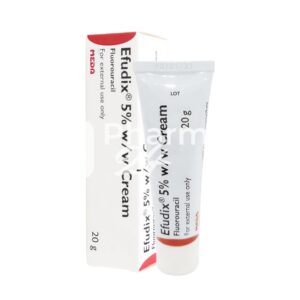
- Efudix is a prescription-only medicine in most countries, including the UK, and is usually supplied by pharmacies and specialist dermatology services; however, some online pharmacies may offer it without a prescription where local regulations allow. It is commonly available as Efudix 5% cream and related fluorouracil topical products.
- Efudix contains fluorouracil and is used to treat actinic keratoses and selected superficial non-melanoma skin cancers, such as superficial basal cell carcinoma. It works as a topical antimetabolite that interferes with abnormal cell growth, helping destroy sun-damaged and precancerous skin cells.
- The usual dose is to apply a thin film to the affected area twice daily, morning and evening. Treatment is typically continued for 2–4 weeks for actinic keratosis and 3–6 weeks for superficial basal cell carcinoma, sometimes longer if advised by a clinician.
- Efudix is for topical administration only, as a cream or solution applied directly to the skin.
- It usually starts working gradually over several days, with redness, burning, and inflammation often appearing early in treatment as the medicine begins to act on the abnormal skin cells.
- The clinical effect lasts for the full treatment course, which is usually 2–4 weeks for actinic keratosis and 3–6 weeks, sometimes up to 12 weeks, for superficial basal cell carcinoma.
- Alcohol does not have a direct known interaction with topical Efudix, but excessive alcohol use may impair healing and worsen skin irritation; use caution if you notice increased sensitivity.
- The most common side effects are local skin reactions, including burning, stinging, pain, redness, dryness, scaling, erosion, ulceration, and photosensitivity at the application site.
- Would you like to try Efudix without a prescription?
Basic Efudix Information
- INN (International Nonproprietary Name): Fluorouracil
- Brand names available in United Kingdom: Efudix, fluorouracil cream, prescription fluorouracil cream, generic fluorouracil
- ATC Code: D06BB03
- Forms & dosages: Topical cream 5%; topical solution 2% and 5%; tubes of 20g, 40g, 50g; bottles of 10mL, 25mL, 30mL
- Manufacturers in United Kingdom: not specified
- Registration status in United Kingdom: Prescription (Rx) only; not OTC
- OTC / Rx classification: Prescription (Rx) only (not OTC)
Latest Research Highlights From The UK And EU, 2022–2025
Has topical fluorouracil changed much in recent years, or is it still the familiar treatment many NHS dermatology teams rely on for sun-damaged skin?
The short answer is that recent UK and EU evidence has stayed broadly consistent with the licensed product information for Efudix and other fluorouracil cream products.
That means the main value remains in field treatment for actinic keratosis and selected superficial non-melanoma skin cancer, rather than in any dramatic new superiority claims over other topical options.
In practical terms, clinicians still use fluorouracil topical treatment because it is well understood, relatively cost-effective, and familiar in dermatology pathways.
| Topic | What Recent UK And EU Evidence Supports | Practical Meaning In NHS Care |
|---|---|---|
| Licensed use | Fluorouracil 5% cream applied twice daily for actinic keratosis for 2–4 weeks, and for superficial basal cell carcinoma for 3–6 weeks, up to 12 weeks | Fits established dermatology pathways and product information |
| Efficacy pattern | Clear local inflammation is expected before the skin improves | Patients are usually told that redness and crusting mean the medicine is working |
| Safety signal | Local pain, burning, stinging, erythema, scaling, erosion and photosensitivity are common | Monitoring focuses on skin reactions and advice on sun protection |
| Serious risk | Systemic reactions are rare with topical use, but can occur in higher-risk patients | Extra caution is needed in people with DPD deficiency or extensive barrier damage |
| UK adoption | Used within dermatology and GP pathways, especially for field therapy | Often chosen where a larger area of actinic damage needs treatment |
For many patients, the key point is that the skin often looks worse before it looks better.
That is not treatment failure.
It is the expected inflammatory response to topical fluorouracil.
In UK practice, this is usually reinforced by the prescriber, community pharmacist, or clinic nurse before the first application is made.
Where diagnosis is uncertain, the medicine is generally kept within specialist or GP-led referral pathways rather than used casually.
Across England and the wider UK, NICE-linked local practice and NHS prescribing habits tend to favour established, licensed treatments such as Efudix for straightforward actinic keratosis treatment, while specialist teams decide on the best option for superficial lesions that need closer follow-up.
Clinical Effectiveness In The UK NHS Context
Why do some patients stop after a few days, then return saying it “made everything red”?
That reaction is very common with Efudix cream and other fluorouracil preparations.
In NHS practice, fluorouracil is used as field therapy for sun-damaged areas, so the aim is not just to treat one visible spot but to clear a broader patch of precancerous change.
Because of that, visible inflammation before improvement is expected, and the benefit is usually measured over weeks rather than days.
Data highlight
Expected response: redness, soreness, crusting and roughness often appear before visible clearance.
Typical adherence issue: people stop early because the reaction looks alarming or feels uncomfortable.
Common reason for follow-up: patients need reassurance that the medicine is working as intended.
UK review points: GP review, dermatology clinic review, or NHS patient portal messaging may be used to check progress.
The standard NHS-style message is simple: keep applying the thin film exactly as advised unless the prescriber tells you to stop.
Where the treatment area becomes very sore, eroded, or infected, clinicians will usually reassess the plan rather than encourage persistence without review.
For many people, the real success is that rough, scaly skin becomes flatter and less obvious over the following weeks, with skin lesion clearance judged after the course rather than during the peak inflammatory stage.
Patients often find it helpful when the pharmacist explains the timeline clearly at the counter or during a remote consultation, because that early counselling can stop avoidable abandonment of therapy.
Indications And Off-Label Uses In UK Practice
What exactly is fluorouracil licensed for, and when does a doctor step outside that label?
That is a fair question, especially when patients see several brand names online and assume all uses are interchangeable.
- Authorised use
- Efudix and other fluorouracil products are licensed for actinic keratosis and superficial basal cell carcinoma.
- Off-label use
- Some dermatologists may discuss field treatment approaches in selected cases where they judge the balance of benefit and risk to be appropriate.
- Not suitable use
- Use without a prescription, use on uncertain lesions, or use where specialist assessment is needed should not be treated as routine self-care.
In the UK, prescription-only supply matters because diagnosis and lesion type influence whether fluorouracil is the right choice.
If a spot is suspicious for something other than actinic keratoses or superficial BCC, referral is often the safer route.
Efudix is widely discussed across Europe and Australia under the same or similar naming, but UK prescribing still depends on clinical judgement, local pathways and the prescriber’s assessment of whether the lesion fits a licensed indication.
That is why community pharmacists are careful not to recommend routine use outside those indications without medical input.
Composition, Strengths And Brand Landscape
Patients often ask whether Efudix cream is “stronger” than fluorouracil cream.
In practice, the active ingredient is fluorouracil either way, and the main question is the strength, formulation and prescribed regimen.
The ATC code is D06BB03, which places fluorouracil in dermatological chemotherapeutics.
| Formulation | Strength | Typical Packaging | Common UK Search Behaviour |
|---|---|---|---|
| Topical cream | 5% | Tubes of 20g, 40g or 50g | Efudix, Efudix cream, fluorouracil 5% cream |
| Topical solution | 2% or 5% | Bottles of 10mL, 25mL or 30mL | Fluorouracil topical, prescription fluorouracil cream, generic fluorouracil |
Across Europe and Australia, the Efudix name is familiar, while some patients in the UK search using brand-led terms such as Efudix, prescription fluorouracil cream or generic fluorouracil.
Packaging and base can affect spreadability and how easily the treatment is applied to the face or scalp, so patient preference can matter even when the active ingredient is the same.
That is why one person may get on better with a cream, while another prefers a topical solution for a specific area.
Contraindications And Special Precautions
Which people should pause and ask a pharmacist or GP before starting treatment?
That question matters because topical chemotherapy still has real safety limits.
- Absolute contraindications
- Known allergy to fluorouracil or any excipient, pregnancy, breastfeeding, and application to eyes, mucous membranes or open wounds.
- Relative precautions
- DPD deficiency, immunocompromise, and a history of severe local reactions to topical chemotherapy.
- Extra caution groups
- Elderly patients may need closer monitoring, even without a formal dose change.
The reason for caution in DPD deficiency is the risk of greater systemic exposure if the medicine is absorbed more than expected.
That risk is still rare with topical use, but it is not zero.
People with fragile or broken skin, or those treating large areas, should be watched more closely for toxicity and for severe local irritation.
It is also wise to avoid direct sun on treated skin, because photosensitivity can make the reaction harder to tolerate.
If the area becomes so sore that washing, shaving, or normal daily activities become difficult, contact the prescriber rather than pushing on without advice.
Dosage Guidelines And Treatment Course
How long should Efudix be used before a patient expects to see a result?
That depends on the condition being treated, but the regimen is generally straightforward.
| Condition | Frequency | Duration | Notes |
|---|---|---|---|
| Actinic keratosis | Apply a thin film twice daily | 2–4 weeks | Continue until sufficient inflammation is seen, as directed |
| Superficial basal cell carcinoma | Apply a thin film twice daily | 3–6 weeks, up to 12 weeks | Usually continued until lesions are eradicated under clinician advice |
For older adults, no routine adjustment is recommended, but sensitivity to adverse effects can be higher, so follow-up matters.
Children should only use it if the prescriber decides the benefit justifies the risk, because safety and efficacy are not established.
Renal or liver impairment does not come with a formal dose change in the product information, but caution is advised and toxicity should be monitored.
If a dose is missed, apply it as soon as you remember unless it is nearly time for the next dose, then skip it.
Do not double up.
Patients who are new to fluorouracil topical treatment often benefit from a simple reminder: thin film, twice daily, and expect irritation before clearance.
Interactions, Lifestyle Factors And Monitoring
Does a topical medicine like this still interact with anything important?
Yes, but the biggest concerns are usually practical rather than food-related.
- Systemic exposure is limited, but risk rises if very large areas are treated or the skin barrier is badly broken.
- Severe inflammation, ulceration or rare systemic toxicity should prompt stopping treatment and urgent advice.
- There is no major food interaction data, so questions about alcohol, tea or coffee are usually less important than skin care and adherence.
- If an unexpected reaction occurs, report it through the MHRA Yellow Card scheme.
In everyday UK pharmacy counselling, patients are often more worried about whether a drink, a hot shower or a cup of tea will change the effect.
The more relevant advice is to protect the area, avoid extra irritation and seek help if the reaction becomes severe or spreads beyond the treated skin.
Rare overdose concerns are mainly linked to accidental ingestion or unusually heavy application over compromised skin.
Cultural Perceptions And Patient Habits In The United Kingdom
Why do so many people search Efudix after they have already been told how to use it?
Because patients like to double-check, especially when the skin reaction looks dramatic.
In the UK, it is common for someone to leave a GP appointment, then read NHS pages, Patient.info, or forum posts that describe redness and crusting.
That can be helpful, but it can also increase worry if the person has not received good counselling first.
Data highlight
Prescriptions are commonly reinforced by Boots, LloydsPharmacy and Superdrug pharmacists.
Many patients now receive e-prescriptions and follow-up advice through NHS portals or online repeat services.
Search patterns such as Efudex cream 5% and Efudix 5% crema shape how people understand the product before they even open the box.
That is why clear explanations matter.
People who are told in advance to expect redness, soreness and crusting are much less likely to stop the course early.
And when the product is discussed in plain English, the medicine feels less alarming and more manageable.
Availability, Access And Pricing Patterns Across The United Kingdom
Can Efudix be obtained in the UK, and does the route of supply change the experience?
Yes, and it often does.
Fluorouracil is prescription-only, so supply runs through NHS or private prescribing routes, with availability varying by pharmacy and region.
| Access Route | Likely Cost Profile | UK Notes |
|---|---|---|
| NHS prescription in England | Standard prescription charge may apply | Repeat supply usually follows GP or dermatology review |
| NHS prescription in Scotland | Generally no standard prescription charge | Fulfilment still depends on local supply |
| NHS prescription in Wales | Generally no standard prescription charge | Prescribing and collection follow normal NHS processes |
| NHS prescription in Northern Ireland | Generally no standard prescription charge | Availability can vary by pharmacy stock |
| Private prescription | Varies by pharmacy and supply route | Electronic prescriptions have made fulfilment easier |
Boots, LloydsPharmacy, Superdrug and online pharmacies all form part of the access picture, with e-prescribing making collection and delivery simpler than it used to be.
In our online pharmacy, efudix is available without a prescription, with discreet delivery to United Kingdom in 5-14 days.
That said, anyone using it should still follow proper medical advice, because the treatment is prescription-only in standard UK clinical practice.
Exact fluorouracil cost details are not always fixed, so it is safer to think in terms of relative affordability, repeat prescribing logistics and whether the pharmacy can source the prescribed pack size.
Comparable Medicines And Prescribing Preferences
What happens if Efudix is not the best fit for a particular patient?
Then the prescriber may consider another topical option.
| Medicine | Pros | Cons |
|---|---|---|
| Aldara (imiquimod) | Useful in some actinic keratosis and superficial BCC cases | Different side effect profile and treatment style |
| Solaraze (diclofenac gel) | Often seen as less inflammatory | May require longer use and may suit some lesions better than others |
| Picato (ingenol mebutate) | Historically used for actinic keratosis | Not the same role in current UK practice |
| Carac / Tolak | Fluorouracil-based alternatives | Formulation differences can affect preference and availability |
Efudix remains attractive because it is familiar, cost-effective and widely used in dermatology.
The trade-off is that it tends to produce stronger local skin reactions than some alternatives.
For that reason, patients who are very concerned about redness or social downtime may prefer a less inflammatory option, even if the alternative has different efficacy, duration or tolerability considerations.
Frequently Asked Questions For UK Patients
- How long does Efudix take to work?
- Most courses run for 2–4 weeks for actinic keratosis and 3–6 weeks, sometimes up to 12 weeks, for superficial basal cell carcinoma.
- Can I use Efudix on my face?
- Yes, if the prescriber has told you to treat that area, but avoid the eyes, lips, mucous membranes and broken skin.
- What if I miss a dose?
- Apply it when you remember unless the next dose is nearly due, then skip it. Do not double up.
- When should I stop and seek help?
- Stop and contact a clinician if pain is severe, the skin looks infected, the medicine gets into the eye, or pregnancy is suspected.
As a rule, treatment should always be guided by the prescriber rather than by internet advice alone.
Correct Use, UK Pharmacist Counselling And Support
What do UK pharmacists usually say when handing over Efudix?
They tend to keep it simple, practical and focused on the skin reaction.
- Wash your hands before and after application.
- Apply a thin film to the prescribed area only.
- Avoid the eyes, mouth, nostrils and other mucous membranes.
- Do not cover the area unless the prescriber has told you to.
- Protect treated skin from sun exposure, because photosensitivity is common.
- Store at room temperature in the original container, away from excessive heat and light, and do not freeze it.
- If you miss a dose, use it when remembered unless the next dose is due soon.
Support does not stop at the pharmacy counter.
People can also use NHS 111, GP review, dermatology clinic follow-up and NHS patient portals if they need written advice or a quick check on a reaction.
If the area becomes very painful, ulcerated, infected or unexpectedly widespread, that is the point to seek clinical review rather than carrying on in silence.
With fluorouracil, good counselling makes a huge difference to confidence and adherence.
Delivery Across United Kingdom
| City | Region | Delivery time |
|---|---|---|
| London | England | 5-7 days |
| Birmingham | England | 5-7 days |
| Manchester | England | 5-7 days |
| Leeds | England | 5-7 days |
| Liverpool | England | 5-7 days |
| Glasgow | Scotland | 5-7 days |
| Edinburgh | Scotland | 5-7 days |
| Cardiff | Wales | 5-7 days |
| Belfast | Northern Ireland | 5-7 days |
| Sheffield | England | 5-7 days |
| Bristol | England | 5-7 days |
| Newcastle upon Tyne | England | 5-7 days |
| Leicester | England | 5-9 days |
| Nottingham | England | 5-9 days |
| Aberdeen | Scotland | 5-9 days |
Final Points To Remember About Efudix
Efudix is a trusted fluorouracil cream used in UK dermatology for actinic keratoses and selected superficial basal cell carcinoma.
It works by causing a controlled local reaction, so redness, crusting and soreness are part of the expected course rather than a reason to panic immediately.
The key is correct application, sensible sun protection, and prompt review if symptoms become severe or unusual.
For patients who want a familiar, established topical chemotherapy option, Efudix remains one of the main names to know.