
Anastrozole
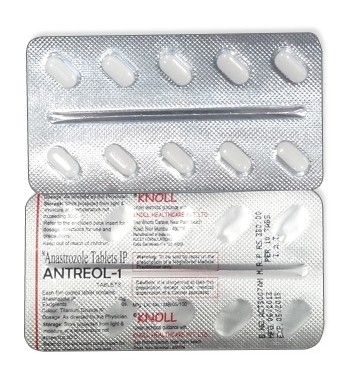
Anastrozole
- In our pharmacy, you can buy anastrozole without a prescription, with delivery in 5–14 days throughout the United Kingdom. Discreet and anonymous packaging.
- Anastrozole is used for hormone-dependent breast cancer, especially in postmenopausal women, including adjuvant and metastatic treatment. It is a non-steroidal aromatase inhibitor that lowers oestrogen levels by blocking the aromatase enzyme.
- The usual dose of anastrozole is 1 mg once daily.
- The form of administration is an oral tablet.
- The effect of the medication begins within a few days, with oestrogen suppression occurring soon after regular dosing.
- The duration of action is about 24 hours, which is why it is taken once daily.
- Do not consume alcohol, as it may worsen side effects such as dizziness, nausea, or liver-related problems.
- The most common side effects are hot flushes, joint pain, fatigue, nausea, headache, and increased cholesterol.
- Would you like to try anastrozole without a prescription?






Latest Research Highlights In The UK And EU
Basic Anastrozole Information
- INN (International Nonproprietary Name): Anastrozole
- Brand names available in United Kingdom: Arimidex; generic anastrozole products may also be supplied depending on stock and prescription route
- ATC Code: L02BG03
- Forms & dosages sold: 1 mg tablets only; no higher strengths, liquid, cream, or vial presentations are reported
- Manufacturers in United Kingdom: AstraZeneca for the original brand; generic suppliers include Teva, Sandoz/Novartis, Cipla, Dr. Reddy’s, Mylan, Accord, Sun Pharma, and Hetero
- Registration status in United Kingdom: Prescription only (Rx)
- OTC / Rx classification: Prescription only (Rx)
Has anything changed in recent UK and EU practice for postmenopausal women with hormone receptor-positive breast cancer?
The short answer is that anastrozole remains a cornerstone aromatase inhibitor in endocrine therapy pathways because the clinical goal is long-term oestrogen suppression, not quick symptom relief.
That matters in adjuvant care after surgery, and also in metastatic disease when benefit continues.
Recent UK and EU evidence published between 2022 and 2025 continues to support the same practical message.
Persistence counts.
Patients who stay on treatment are more likely to keep the recurrence risk down than patients who stop early because of joint pain, hot flushes, or sleep disruption.
Arimidex remains the best-known brand in the UK, while EU markets also commonly use generics such as Anastrozole Teva and Anastrozole Sandoz.
As an endocrine therapy classified under ATC code L02BG03, anastrozole is a prescription-only medicine in real-world practice, even when patients search for convenience or compare access options.
| UK/EU evidence focus | Clinical finding | Practical takeaway |
|---|---|---|
| Postmenopausal breast cancer | Recurrence reduction remains a consistent benefit with aromatase inhibitors | Supports anastrozole as a core option in adjuvant pathways |
| Long-term endocrine suppression | Benefit depends on persistence over months and years | Adherence support is as important as the prescription itself |
| Tolerability | Joint pain, hot flushes, fatigue, and sleep problems remain common reasons for stopping | Active counselling can improve continuation |
| Bone-related safety | Decreased bone mineral density and osteoporosis risk need monitoring | Bone health reviews should be built into follow-up |
For many people, the question is not whether anastrozole works, but whether they can keep taking it day after day.
That is where oncology nurses, pharmacists, and NHS review systems make a real difference.
Clinical Effectiveness In NHS Practice
Why do NHS teams still rely on anastrozole so heavily for postmenopausal breast cancer?
Because the medicine fits the biology.
In women after the menopause, aromatase inhibitors reduce the body’s oestrogen production and help suppress hormone receptor-positive disease.
In adjuvant treatment, the usual course can run for up to 5 years, while metastatic disease may continue longer if the patient is still benefiting.
That is why anastrozole tablets for breast cancer are not judged just by early symptom control.
They are judged by recurrence prevention, disease control, and whether a patient can realistically keep going.
The patient experience is mixed but very recognisable in NHS clinics.
A woman may feel reassured because treatment is actively reducing recurrence anxiety, yet also struggle with joint pain, hot flushes, fatigue, or broken sleep.
Available data highlights the trade-off clearly.
| Expected benefit | Common burden | NHS support point |
|---|---|---|
| Lower recurrence risk in appropriate patients | Arthralgia and stiffness | Review pain control and mobility advice |
| Useful disease control in metastatic settings | Hot flushes and fatigue | Check sleep, hydration, and timing of medicines |
| Once-daily dosing | Adherence can still slip over time | Pharmacist and nurse follow-up helps persistence |
- Joint pain or stiffness that starts after treatment begins.
- Hot flushes that interfere with work, caring, or sleep.
- Fatigue that builds up rather than settling.
- Sleep disruption that makes the medicine feel harder to tolerate.
The practical point is simple.
Anastrozole is available as 1 mg tablets only, so there is no liquid or cream version to swap to.
That means adherence support, not formulation changes, is usually the answer in NHS breast cancer treatment.
Indications And Expanded Uses
What is anastrozole actually approved for?
Its MHRA-approved use is clear: postmenopausal women with hormone receptor-positive breast cancer, in both adjuvant and metastatic settings.
It is not standard treatment for premenopausal women in routine breast cancer care, and it is not a general hormone therapy for unrelated symptoms.
Any off-label prescribing should only happen under specialist-led oncology care, whether in NHS pathways or private oncology settings.
- Adjuvant
- Treatment given after the main cancer treatment to lower the risk of the cancer coming back.
- Metastatic
- Cancer that has spread beyond the original site to other parts of the body.
- Hormone receptor-positive
- Cancer cells that use hormones, especially oestrogen, to grow and survive.
In the UK, Arimidex is the brand name many people recognise first.
Across Europe, generic products are also widely used, including Anastrozole Teva and Anastrozole Sandoz.
Those names can sound different on the box, but the therapeutic role is the same when the product is the same strength and supplied appropriately.
Composition And Brand Landscape
Ever looked at the box and wondered whether a generic really is the same medicine?
With anastrozole, the active ingredient is straightforward: 1 mg tablets, and no higher strengths are available.
There are no cream, liquid, or vial presentations in the supplied product data.
The original manufacturer is AstraZeneca, while generic suppliers include Teva, Sandoz/Novartis, Cipla, Dr. Reddy’s, Mylan, Accord, Sun Pharma, and Hetero.
UK patients may receive a generic equivalent depending on stock, sourcing, and the way the prescription is written.
| Brand | Region | Packaging | Manufacturer |
|---|---|---|---|
| Arimidex | UK, EU, US, Canada | 1 mg tablets, blister or bottle, 28 or 30 per pack | AstraZeneca, local licensees |
| Anastrozole Teva | EU | 1 mg tablets, blisters | Teva Pharmaceuticals |
| Anastrozole Sandoz | EU | 1 mg tablets, blisters | Sandoz (Novartis division) |
| Anatrole | Australia | 1 mg tablets, blisters | Generic suppliers |
| Aristozole | India, Asia | 1 mg tablets | Various local pharma |
| Odesra | Canada | 1 mg tablets | Various |
For British shoppers comparing anastrozole brands UK wide, the main issue is usually supply and recognition rather than a different treatment aim.
That is why a patient may see Arimidex 1mg one month and a generic the next.
Contraindications And Special Precautions
Who should not take anastrozole?
The absolute contraindications are known hypersensitivity to anastrozole or any tablet component, pregnancy, and lactation.
It is also not indicated for premenopausal women in routine breast cancer care.
Some patients need extra monitoring rather than an outright stop.
That includes people with severe hepatic impairment, severe renal impairment, pre-existing ischaemic heart disease, or osteoporosis and high fracture risk.
Long-term use can reduce bone mineral density, so bone health needs proper attention.
Cardiovascular risk is not the main headline with this medicine, but it still matters in patients with existing heart disease.
Driving is usually not directly restricted, but dizziness or fatigue can make it sensible to take extra care.
Alcohol advice should be general and cautious rather than absolute.
- Tell your GP or oncology team if joint pain is becoming difficult to manage.
- Speak to a pharmacist if you are unsure whether a rash, headache, or fatigue is medicine-related.
- Contact your team promptly if you become pregnant, or if pregnancy is possible.
- Ask for review if you have bone pain, reduced mobility, or a fracture history.
- Get medical advice urgently for chest symptoms or severe allergic reactions.
Bone monitoring is particularly important when treatment continues for months or years.
Dosage Guidelines
What dose is used in UK practice?
The standard regimen is 1 mg orally once daily for hormone receptor-positive breast cancer.
Keeping the timing consistent helps habits settle.
If a dose is missed, it should be taken as soon as remembered on the same day.
If it is close to the next scheduled dose, skip the missed dose and continue as normal.
Do not double up.
| Patient group | Usual approach |
|---|---|
| Children | Not recommended; safety and efficacy are not established |
| Elderly | No adjustment required |
| Liver impairment | Mild to moderate: no significant adjustment needed; severe: use with caution |
| Renal impairment | Mild to moderate: no adjustment needed; severe: use with caution |
Adjuvant treatment is typically continued for up to 5 years.
In metastatic disease, it may continue for months to years as long as there is clinical benefit.
That is one reason adherence matters so much in breast cancer regimen planning.
Interactions Overview
Could another medicine interfere with anastrozole?
Yes, one of the most important interaction checks is tamoxifen.
Co-administration reduces anastrozole levels and should be avoided.
No direct effect on adrenal corticosteroids or aldosterone is expected, but patients should still report all prescribed medicines, hormone therapies, supplements, and over-the-counter products.
Food restrictions are not specified in the data provided, but sensible alcohol moderation remains good pharmacy advice.
- Check for tamoxifen use before starting or dispensing.
- Ask about all cancer medicines and any hormone treatment.
- Review supplements, especially if the patient is buying medicines privately.
- Use the MHRA Yellow Card route if a suspected adverse reaction needs reporting.
That sort of pharmacy counselling often prevents confusion later, especially when patients are switched between brands.
Cultural Perceptions And Patient Habits
Who do patients ask first when something feels off?
In the UK, it is often the pharmacist.
That is especially true for side effects, brand changes, or supply problems, because people may not want to wait for the next GP appointment.
In patient communities such as Patient.info and Mumsnet, the same concerns come up again and again: joint pain, hot flushes, weight changes, and whether a generic brand feels different.
NHS 111 is also a familiar safety net, particularly when symptoms appear at the weekend or during a bank holiday.
Oncology nurses and NHS patient portals have made a noticeable difference too, because patients can check prescriptions, appointments, and follow-up plans more easily.
Some people strongly prefer the name Arimidex because it feels familiar.
Others are switched to Anastrozole Teva or Anastrozole Sandoz because of availability or procurement routes.
- Brand switch
- Changing from one manufacturer’s version to another, while keeping the same active ingredient and strength.
- Generic substitution
- Supplying a non-brand version of the same medicine when appropriate.
- Counselling
- Clear advice from a pharmacist or nurse about how to take the medicine and what to watch for.
- A patient notices a different-looking box and worries it is the wrong medicine.
- Someone calls after a Friday-evening order because they are unsure whether the brand changed.
- A patient asks whether “generic” means weaker, when the issue is actually supply and packaging.
That is exactly where calm, plain-language pharmacy support helps most.
For people who need discreet access, our online pharmacy offers anastrozole without a prescription, with discreet delivery to the United Kingdom in 5-14 days.
Availability And Pricing Patterns
How do people usually get anastrozole in the UK?
Most patients access it through NHS prescriptions, while some buy privately when speed or convenience matters.
Boots, LloydsPharmacy, and Superdrug are well-known high-street routes, and online pharmacies increasingly dispense electronically when a valid prescription is in place.
The cost difference can be significant.
NHS supply usually reduces the price far more than private purchase, although prescription charges and exemption rules vary across England, Scotland, Wales, and Northern Ireland.
Packaging may also vary by country and supplier, with 28 or 30 tablets per pack seen in some markets.
| Access route | Typical features | Cost pattern |
|---|---|---|
| NHS prescription | Most familiar route for breast cancer treatment in the UK | Usually the lowest cost to the patient |
| Private pharmacy | Useful when a patient is paying directly or needs a different supply route | Usually higher than NHS supply |
| Online pharmacy | Convenient for repeat dispensing and discreet delivery | Varies by supplier and prescription route |
For patients comparing anastrozole price UK wide, the main thing to check is that the medicine, strength, and supply route match the prescription and oncology plan.
Comparable Medicines And Preferences
Should someone ask for anastrozole, letrozole, exemestane, or tamoxifen?
It depends on the cancer plan, menopausal status, prior treatment, and how side effects are being handled.
Letrozole is another non-steroidal aromatase inhibitor with the same main indications.
Exemestane is steroidal and works a little differently.
Tamoxifen is different again because it is a SERM, not an aromatase inhibitor.
Choice often comes down to what has already been tried and what the patient can tolerate.
- Pros: once-daily dosing, strong endocrine suppression, generic availability.
- Pros: well established in NHS oncology pathways.
- Cons: joint pain, hot flushes, fatigue, insomnia, and bone loss risk.
- Cons: cholesterol may increase, so follow-up matters.
For many patients, anastrozole vs letrozole dosages is not the real issue.
The real question is which aromatase inhibitor best fits the treatment history and side-effect profile.
Frequently Asked Questions
How long do I need to take anastrozole?
In adjuvant care, treatment is commonly continued for up to 5 years.
In metastatic disease, it may continue for as long as it is still helping.
What if I miss a dose?
Take it the same day when you remember.
If it is nearly time for the next dose, skip the missed one and carry on.
Can I take it with tamoxifen?
No.
Tamoxifen reduces anastrozole levels and should be avoided together unless a specialist has a very specific reason.
Why has my pharmacy given me a different brand?
That usually means a generic substitution or a supply change, not a different treatment.
Any new bone pain, chest symptoms, or severe rash should be reviewed promptly.
Guidance For Proper Use
What should patients do day to day with anastrozole?
Take 1 mg once daily, keep the tablets in the original packaging, and store them at room temperature.
Protect the medicine from moisture and heat.
Never double a missed dose.
Anastrozole is prescription only and should be used under GP or specialist supervision.
UK pharmacists usually spend time on bone protection, symptom reporting, and practical adherence support because those are the issues that most often shape whether treatment continues.
Reminder tools can help.
So can NHS portals, oncology teams, and repeat prescription tracking.
- Contact your oncology team if side effects are getting harder to manage.
- Speak to your pharmacist if a brand change is confusing or if supply is delayed.
- Ask your GP or specialist about bone health monitoring if you are on long-term treatment.
- Use a reminder app, pill box, or phone alarm if doses are being missed.
- Seek prompt advice for severe rash, chest symptoms, or new bone pain.
Delivery Across United Kingdom
| City | Region | Delivery time |
|---|---|---|
| London | England | 5-7 days |
| Birmingham | England | 5-7 days |
| Manchester | England | 5-7 days |
| Liverpool | England | 5-7 days |
| Leeds | England | 5-7 days |
| Glasgow | Scotland | 5-7 days |
| Edinburgh | Scotland | 5-7 days |
| Cardiff | Wales | 5-7 days |
| Belfast | Northern Ireland | 5-7 days |
| Sheffield | England | 5-9 days |
| Bristol | England | 5-9 days |
| Newcastle upon Tyne | England | 5-9 days |
| Nottingham | England | 5-9 days |
| Leicester | England | 5-9 days |