
Imiquimod
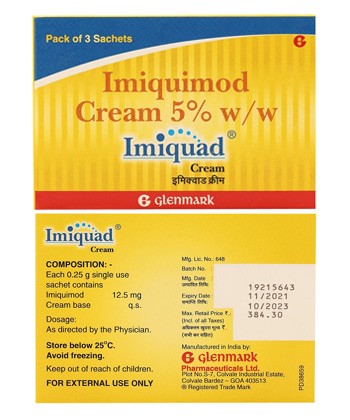
Imiquimod
- In our pharmacy, imiquimod can be bought without a prescription, with delivery available in the United Kingdom in discreet packaging. In many countries, however, it is prescription-only (Rx), so local rules should be checked before purchase.
- Imiquimod is used for actinic keratosis, superficial basal cell carcinoma, and external genital or perianal warts. It is an immune response modifier that helps the body produce interferons and other cytokines to boost local immune activity against abnormal or virus-infected cells.
- The usual dose depends on the condition: for actinic keratosis, apply a thin layer 2 times per week; for superficial basal cell carcinoma, 5 times per week; and for external genital or perianal warts, 3 times per week on alternate days. Follow the prescribed treatment plan exactly.
- The form of administration is topical cream, most commonly 5% cream in sachets and, in some markets, 3.75% cream in tubes or sachets.
- Imiquimod does not work like a pain reliever, so there is no immediate onset. Local skin reactions may appear within the first few applications, while the full therapeutic effect is usually seen over several weeks.
- The duration of action varies by indication and regimen: around 8 hours after each application on the skin, with treatment courses typically lasting 6 weeks for superficial basal cell carcinoma, 16 weeks for actinic keratosis, and up to 16 weeks for genital or perianal warts.
- Avoid alcohol excess during treatment, especially if you feel flu-like symptoms or general malaise, as alcohol may make you feel worse. Topical imiquimod has no major direct alcohol interaction, but moderation is advisable.
- The most common side effects are local skin reactions such as redness, swelling, erosion, scabbing, flaking, itching, burning, and pain. Headache, fatigue, muscle aches, and flu-like symptoms can also occur.
- Would you like to try imiquimod without a prescription?
Latest Research And Safety Signals For Imiquimod
Basic Imiquimod Information
- INN (International Nonproprietary Name): Imiquimod
- Brand names available in United Kingdom: Aldara
- ATC Code: D06BB10
- Forms & dosages: Cream, 5% (50 mg/g, 12.5 mg/250 mg); Cream, 3.75%
- Manufacturers in United Kingdom: Meda AB, Viatris
- Registration status in United Kingdom: Prescription-only (Rx)
- OTC / Rx classification: Prescription-only (Rx)
What does the newer UK and EU evidence actually tell patients about imiquimod?
The most solid recent regulatory information still comes from EMA product data and MHRA-aligned labelling for Aldara cream, which remains prescription-only in the UK and across the EU.
That matters because imiquimod is not a direct antiviral or a cytotoxic cream.
It is an immune response modifier, so its effect depends on triggering local cytokines and interferon rather than killing tissue outright.
Across post-marketing use from 2022 to 2025, the pattern is familiar and clinically useful.
Local redness, swelling, erosion, scabbing, flaking, itching, burning and pain are expected reactions.
Systemic effects such as headache, flu-like symptoms, myalgia and fatigue can happen, but they are uncommon.
In practical terms, a sore, inflamed area often means the cream is doing something, not that harm is occurring.
Where the evidence is strong, it supports approved use for actinic keratosis, superficial basal cell carcinoma and external genital or perianal warts.
Where the evidence is thinner, it is mostly around long-term outcomes, recurrence rates and how well results hold over years rather than weeks.
That is especially true for actinic keratosis and superficial basal cell carcinoma, where treatment response is useful but long-term comparative data remain limited.
For genital and perianal warts, symptom control and lesion clearance are well established enough for routine use, but recurrence can still occur and follow-up remains important.
| Use | Efficacy signal | Tolerability signal | Evidence strength |
|---|---|---|---|
| Actinic keratosis | Good short-term clearance with scheduled use | Local inflammation is common and expected | Moderate, with limited long-term outcome data |
| Superficial basal cell carcinoma | Useful in selected small superficial lesions | Local skin reactions often limit comfort | Moderate, but long-term durability data are limited |
| External genital or perianal warts | Established option for patient-applied treatment | Inflammation can be brisk, especially with overuse | Good for routine clinical use, though recurrence still matters |
The overall safety picture has not shifted in a dramatic way.
That is reassuring for people searching for Aldara cream, Imiquimod 5% cream or an Aldara sachet in the UK.
It is still the same basic story: local action first, systemic reactions rarely, and careful use because the skin response can look dramatic.
Clinical Effectiveness In NHS And UK Practice
How does imiquimod usually feel in real NHS practice?
Most patients notice a gradual local reaction rather than instant clearance.
Redness, soreness and a burning sensation often appear after a few applications, and that is frequently the point where people worry the treatment is doing damage.
In reality, these reactions often show that the immune response modifier is working on the treated area.
What matters most is staying within the prescribed schedule and not layering on extra cream because the patch looks unchanged after a few doses.
Adherence is central to outcomes.
In clinic, incomplete courses are a common reason for poor results, particularly when treatment fatigue sets in or the visible skin reaction puts people off continuing.
Some people can tolerate the reaction and carry on.
Others need a short pause, a review or clearer counselling before restarting.
That is normal NHS-style management, especially when the aim is to finish a course safely rather than push through severe irritation.
Benefits and challenges tend to be very practical in the UK.
- Benefits: home use, no need for destructive procedures in many cases, and useful treatment for several small lesions.
- Benefits: prescription cream access through GP, dermatology or sexual health pathways, with pharmacy support for counselling.
- Challenges: redness, soreness and visible inflammation can be alarming.
- Challenges: treatment fatigue can lead to missed doses or early stopping.
- Challenges: if inflammation becomes too intense, therapy may need to be paused and reviewed.
Across England, Scotland, Wales and Northern Ireland, access is still shaped by local pathways.
Electronic prescriptions and repeat dispensing make repeat supply easier in some settings, while other patients are managed through GP review, dermatology follow-up or sexual health services.
For pharmacy teams, the main role is often practical counselling: how to apply it, what to expect, and when to get back in touch.
That sort of advice is exactly what people look for late on a Friday evening when the sachet arrives and the first reaction begins.
In our online pharmacy, imiquimod is available without a prescription, with discreet delivery to United Kingdom in 5-14 days.
Approved Uses And Common Specialist Discussions
Which uses are actually approved, and which are more specialist-led conversations?
The approved adult indications are straightforward: actinic keratosis, superficial basal cell carcinoma and external genital or perianal warts.
Those are the conditions backed by the product data for Aldara in the UK and EU.
- Approved use
- Actinic keratosis, superficial basal cell carcinoma, and external genital or perianal warts.
- Specialist discussion
- Off-label or non-standard use in dermatology or sexual health, always guided by local policy and clinician judgement.
- Paediatric use
- Not generally recommended in children under 12 years, except in special cases.
- Higher-risk patients
- People who are immunocompromised, have autoimmune disease, or present with unusual lesions need specialist advice.
The standard adult regimens are the ones most UK patients want in plain English.
For actinic keratosis, the cream is applied twice weekly.
For superficial basal cell carcinoma, it is usually applied five times weekly.
For external genital or perianal warts, the usual schedule is three times weekly on alternate days.
Those schedules are central to Imiquimod indications and to sensible NHS prescribing.
The reason clinicians are careful here is simple.
Local inflammation is expected, but the wrong lesion, the wrong area or the wrong patient group can make treatment harder to tolerate.
That is why Aldara for warts, Imiquimod for basal cell carcinoma and actinic keratosis cream use should always follow the clinician’s advice rather than internet guesses.
Composition, Strengths And UK Brand Landscape
What exactly is the medicine you are seeing on the box?
Imiquimod is the active ingredient, and Aldara is the main UK and EU brand name.
In some markets, Zyclara cream is available as a 3.75% formulation, while Aldara is the well-known 5% option.
The pack style matters more than many people think.
Single-use sachets help with hygiene, dosing accuracy and convenience, especially when treatment is applied to small areas on different days.
That packaging also helps reduce waste, because the cream is designed to be used once and discarded.
Imiquimod sits in topical dermatological chemotherapeutics, with ATC code D06BB10.
People often search using terms such as Aldara sachet, Imiquimod 5% cream or Aldara cream, so those are the names most likely to appear in UK product searches.
| Formulation | Strength | Usual packaging | Typical UK search term |
|---|---|---|---|
| Imiquimod cream | 5% | Single-use sachets | Aldara sachet |
| Imiquimod cream | 3.75% | Tubes or sachets | Zyclara 3.75% cream |
Short glossary
- INN: the international non-proprietary name, here imiquimod.
- ATC code: D06BB10.
- Sachet: a single-use pack containing a measured amount of cream.
- 5% cream: the standard Aldara strength in UK and EU branding.
Who Should Not Use It, And Who Needs Extra Caution
When should imiquimod be avoided altogether, and when is extra caution the safer answer?
The clearest contraindication is hypersensitivity to imiquimod or any excipient in the product.
The cream should also be avoided on broken or ulcerated skin and on mucous membranes.
That matters because these surfaces can absorb more medicine and are more likely to react badly.
| Group | Advice | Why it matters |
|---|---|---|
| Known hypersensitivity | Do not use | Risk of allergic or severe local reaction |
| Broken, ulcerated skin or mucous membranes | Do not use on these areas | Higher irritation and absorption risk |
| Autoimmune disorders | Use with caution and specialist advice | Immunostimulatory effect may worsen symptoms |
| Severe inflammatory skin disease | Use with caution | Local inflammation may be harder to control |
| Organ transplant recipients | Specialist advice required | Immune effects need careful review |
| Pregnancy or breastfeeding | Specialist advice needed | Individual risk-benefit assessment is sensible |
Older adults usually do not need routine dose adjustment.
Renal or hepatic impairment does not have an established adjustment schedule, but monitoring is sensible because systemic absorption and immune effects can be less predictable.
For patient safety, the main question is not “Can this be used by everyone?” but “Is this the right patient, at the right site, with the right supervision?”
How To Use Imiquimod Safely In The United Kingdom
People often want one simple answer: how is imiquimod actually used?
The short answer is that the exact regimen depends on the condition being treated, and the cream is left on for a set time before washing off.
For actinic keratosis and superficial basal cell carcinoma, the usual leave-on time is about eight hours.
For external genital or perianal warts, the usual leave-on time is six to ten hours.
- Wash and dry the affected area first.
- Apply a thin layer of cream to the prescribed area only.
- Use the sachet once and discard any remainder.
- Avoid the eyes, mouth, nose, broken skin and mucous membranes.
- Wash your hands after application.
- Leave the cream on for the prescribed time, then wash it off.
- Use the medicine exactly on the days advised by the clinician.
If a dose is missed, apply it as soon as remembered unless the next dose is nearly due.
Overdose is not usually described in topical use, but the area should be washed thoroughly if too much has been applied and medical advice should be sought if symptoms develop.
If the reaction becomes too intense, clinicians may tailor use by pausing treatment or reducing frequency, because comfort and completion often matter more than forcing the schedule.
Interactions, Daily Life And Safety Reporting
What do patients usually ask about interactions?
They often ask about alcohol, tea, coffee, other creams, and whether they can go out in the sun.
For a topical treatment, food and drink interactions are not a major issue.
That said, inflamed skin can feel worse with heat, sweating, sun exposure and friction.
So a gym session, tight clothing or a hot bath can make a reactive patch sting more than usual.
Other topical medicines can also irritate the same area, which is why it is worth telling the prescriber about steroid creams, exfoliants or other immune-modulating treatments.
It is also important to mention any planned procedure in the treated area.
That includes dermatology procedures, minor surgery or sexual health follow-up where the skin needs to settle first.
- Consider: heat, sweating, friction and sun exposure over inflamed skin.
- Avoid combining casually: other irritating topical products on the same area.
- Tell the clinician: about steroids, immune-modulating therapies or planned procedures.
- Report: unexpected or serious reactions through MHRA Yellow Card.
Serious drug conflicts are not common with imiquimod, but unusual reactions should still be reported so the safety picture stays accurate.
How Patients In The United Kingdom Usually Talk About It
Why do so many people ask a pharmacist first?
Because treatment can look dramatic before it looks better.
That is where UK pharmacist advice matters, especially when someone has seen the first patch turn red and is wondering whether to stop immediately.
People also check NHS 111, patient portals and forums for reassurance, which is very common with treatments applied to visible skin or sensitive areas.
Questions seen time and again include whether redness is normal, whether work is still possible, and why the cream stings so much.
Those are sensible questions, not overreactions.
Pharmacy teams at Boots, LloydsPharmacy and Superdrug are often trusted because patients want plain language and a quick reality check.
Online pharmacy messaging and digital prescription services are now part of the same conversation, because many people want discreet support without waiting for a call back.
Typical reassurance points
- Redness, soreness and stinging are common and can mean the medicine is active.
- Severe pain, ulceration or flu-like symptoms should be reviewed promptly.
- It is normal to need counselling more than once during a course.
- Clear written instructions help patients stay on track.
Availability, Pricing And Access Across The United Kingdom
How do people get imiquimod in the UK?
Usually through an NHS prescription, a private prescription, or electronic dispensing via an online pharmacy.
It remains prescription-only in the UK, so access normally sits within GP, dermatology or sexual health pathways.
That said, private purchase searches are common, especially for terms like Aldara price or Imiquimod cream buy.
Pricing and payment can differ across England, Scotland, Wales and Northern Ireland because prescription charging policies and local dispensing arrangements are not identical.
Some patients pay NHS prescription charges, while others receive their medicine under local exemption rules or prescribed care pathways.
Recognisable pharmacy chains such as Boots, LloydsPharmacy and Superdrug are familiar access points for many patients, although availability still depends on stock and local prescribing arrangements.
| Access route | Typical context | Payment context |
|---|---|---|
| NHS prescription | GP, dermatology or sexual health pathway | Depends on UK nation and exemption status |
| Private prescription | Private clinic or consultant-led care | Patient pays prescription and dispensing costs |
| Online pharmacy | Electronic supply and counselling | Usually private payment unless otherwise arranged |
For patients comparing options, the most important detail is not just the headline price but the whole pathway: consultation, prescription, supply and follow-up.
Alternatives And Comparator Treatments
What if imiquimod is not the best fit?
UK clinicians may choose a different option depending on the lesion, the location and how much irritation the patient can manage.
The main comparators are podophyllotoxin topical for genital warts, 5-fluorouracil cream for actinic keratosis and some superficial skin cancers, and cryotherapy for actinic keratosis or warts.
Ingenol mebutate is best treated carefully in search intent because it has been withdrawn in some markets.
| Treatment | Main advantage | Main drawback |
|---|---|---|
| Imiquimod | Home use and non-destructive immune response modifier | Local inflammation can be intense |
| Podophyllotoxin topical | Patient-applied option for genital warts | Different suitability depending on lesion type |
| 5-Fluorouracil cream | Established option for actinic keratosis and superficial lesions | Also causes local irritation |
| Cryotherapy | Quick in-clinic treatment | Not self-applied and may need repeat visits |
Quick checklist
- Efficacy: imiquimod is useful for selected lesions, especially when a home-based approach is preferred.
- Convenience: it is often easier to self-apply than to attend repeated procedures.
- Reaction: visible inflammation is more common than with some alternatives.
- Cost: varies by access route and prescription pathway.
- Suitability: best for small, appropriate lesions and the right clinical setting.
Frequently Asked Questions About Imiquimod
How long does redness last after imiquimod?
Redness can last for as long as the skin is reacting to treatment, and that can vary by site and strength.
If it becomes severe, painful or ulcerated, the clinician should review it.
Can a dose be missed?
Yes, it can happen.
Apply it when remembered unless the next scheduled dose is close, then skip the missed one.
Can it be used on the face or genitals?
It is used on certain approved lesions, including external genital or perianal warts, but it should only be used exactly as prescribed and never on mucous membranes.
When should treatment stop and a clinician be contacted?
Persistent severe pain, ulceration, marked swelling or flu-like symptoms need review.
That is the line between expected local irritation and an over-reaction that needs medical advice.
Correct Use, Storage And Pharmacist Support
What is the safest way to finish the course properly?
The answer is usually simple, but it needs discipline.
- Wash and dry the area before application.
- Apply a thin layer only to the treated skin.
- Use each sachet once and keep unopened sachets sealed until needed.
- Wash hands after applying the cream.
- Do not put it on broken skin or mucous membranes.
- Follow the prescribed timing exactly before washing it off.
- Store at room temperature, away from freezing and excessive heat.
That storage advice matters more than it sounds.
Imiquimod should be kept at room temperature, roughly 15 to 25°C, with sachets protected until use.
For support, the most useful UK signposts are NHS patient leaflets, NHS website pages, GP review, sexual health clinics and direct pharmacy counselling.
The practical aim is not just supply.
It is helping people recognise the difference between normal local inflammation and a reaction that needs to be checked.
With the right advice, most patients can complete the course safely and know when to ask for help.
Delivery Across United Kingdom
| City | Region | Delivery time |
|---|---|---|
| London | England | 5-7 days |
| Birmingham | England | 5-7 days |
| Manchester | England | 5-7 days |
| Liverpool | England | 5-7 days |
| Leeds | England | 5-7 days |
| Sheffield | England | 5-7 days |
| Bristol | England | 5-7 days |
| Edinburgh | Scotland | 5-7 days |
| Glasgow | Scotland | 5-7 days |
| Cardiff | Wales | 5-7 days |
| Belfast | Northern Ireland | 5-7 days |
| Coventry | England | 5-9 days |
| Nottingham | England | 5-9 days |
| Aberdeen | Scotland | 5-9 days |
| Swansea | Wales | 5-9 days |