
Danol
Danol
- Danol (danazol) can be purchased from pharmacies in the UK and other countries where it is registered, but it is normally a prescription-only medicine (Rx). It should not be supplied without a doctor’s prescription.
- Danol is used for endometriosis, fibrocystic breast disease, and hereditary angioedema. It works as a pituitary suppressant with weak androgen and anti-oestrogen activity, helping to reduce hormone-related symptoms.
- The usual dose depends on the condition: endometriosis 200 mg daily in two divided doses; fibrocystic breast disease 100–400 mg daily; hereditary angioedema 200 mg daily initially, with possible maintenance at 50–100 mg daily. Your doctor may adjust the dose.
- Danol is taken by mouth as capsules, available in strengths of 50 mg, 100 mg, and 200 mg.
- It may begin to work within days to a few weeks, but for some conditions such as endometriosis or fibrocystic breast disease, full benefit is usually assessed after several weeks of treatment.
- The duration of action requires regular daily dosing; treatment courses commonly last 3–6 months for endometriosis, 4–6 months for fibrocystic breast disease, and longer-term maintenance may be needed for hereditary angioedema at the lowest effective dose.
- Avoid alcohol, as both alcohol and Danol can increase the risk of liver problems and may worsen side effects.
- The most common side effects are weight gain, acne, oily skin, hirsutism, voice changes, menstrual disturbances, hot flushes, mood changes, and breast size reduction.
- Would you like to try Danol with a prescription, or speak to a healthcare professional about whether it is suitable for you?


Latest UK And EU Research On Danazol: What Evidence Still Supports Its Use
- INN (International Nonproprietary Name): Danazol
- Brand names available in United Kingdom: Danocrine, Danol
- ATC Code: G03XA01
- Forms & dosages: Capsules 50 mg, 100 mg, 200 mg
- Manufacturers in United Kingdom: Sanofi, Aspen Pharmacare, Teva UK, and other generic suppliers
- Registration status in United Kingdom: MHRA approved as prescription medicine; EMA availability is selective across EU countries
- OTC / Rx classification: Prescription-only medicine
Does danazol still have a place when newer hormonal treatments are often discussed first?
In UK and EU practice, the answer is yes, but only in selected cases where older evidence still matters.
Danazol has longstanding clinical evidence in endometriosis treatment evidence, fibrocystic breast disease, and hereditary angioedema, yet modern practice increasingly compares it with GnRH agonists, GnRH antagonists, and progestins.
The MHRA lists it as a prescription medicine in the UK, while EMA registration is not universal across the EU, so access depends on country and supply chain.
It is also FDA-approved for endometriosis, fibrocystic breast disease, and hereditary angioedema, which helps explain why it remains a recognised prescription medicine UK clinicians may still consider.
Research themes tend to focus less on “cure rates” and more on symptom control, tolerability, and whether lower-dose maintenance can reduce adverse effects.
| Study Focus | Population | Outcome | Safety Signal |
|---|---|---|---|
| Endometriosis symptom control | Adults with persistent pain | Reduced pain and improved function in selected patients | Androgenic effects limited long-term use |
| Fibrocystic breast disease | Patients with cyclical breast pain | Improved breast tenderness and discomfort | Weight gain and voice change affected adherence |
| Hereditary angioedema prevention | Patients with recurrent attacks | Fewer swelling episodes with maintenance therapy | Liver and lipid monitoring remained important |
Data highlight: lower-dose maintenance may reduce adverse effects, especially when patients respond well after the initial phase.
Clinical Effectiveness In NHS-Relevant Conditions
What does danazol actually help with in day-to-day practice?
For endometriosis, the main aim is easing pain and reducing hormone-driven disease activity, usually with a starting dose of 200 mg/day divided twice daily, and treatment often lasting 3 to 6 months.
In resistant cases, the dose may be increased, with some regimens reaching up to 800 mg/day, although that is not routine and is usually limited by tolerability.
For fibrocystic breast disease, the expected gain is less breast pain and less cyclical discomfort, using 100 to 400 mg/day for around 4 to 6 months.
For hereditary angioedema, the benefit is fewer swelling episodes, often starting at 200 mg/day and then reducing to 50 to 100 mg/day for maintenance when possible.
In the NHS setting, clinicians often reserve danazol for selected patients who have not responded well to other hormonal therapies or where those options are unsuitable.
Adherence matters because androgenic side effects can make patients stop treatment early, even when symptoms improve.
| Condition | Typical Dose | Usual Duration | Main Outcome |
|---|---|---|---|
| Endometriosis | 200 mg/day | 3 to 6 months, sometimes longer | Pain reduction |
| Fibrocystic breast disease | 100 to 400 mg/day | 4 to 6 months | Less breast tenderness |
| Hereditary angioedema | 200 mg/day, then lower maintenance if needed | Ongoing maintenance | Fewer swelling episodes |
Indications And Where Danazol Fits In UK Prescribing
Which patients are actually offered danazol in the UK?
Its core indications are the same across most recognised prescribing pathways, but the place it holds in treatment is quite selective.
- Endometriosis
- May be considered when pain remains troublesome and other hormonal approaches have not worked or are not suitable.
- Fibrocystic breast disease
- May be used where cyclical breast pain and nodularity need treatment after other measures have failed.
- Hereditary angioedema
- May be used as maintenance treatment to reduce attack frequency under specialist review.
Danazol is a prescription-only medicine, so it is not available over the counter in the UK.
Prescribing must be clinician-led, with the choice shaped by fertility goals, symptom burden, monitoring needs, and previous response to treatment.
Private clinics may discuss danazol differently from NHS services because regular monitoring and side-effect counselling are part of responsible use.
Fertility usually returns in 2 to 3 months after stopping, which is an important point in family-planning discussions.
Composition, Strengths, And UK Brand Landscape
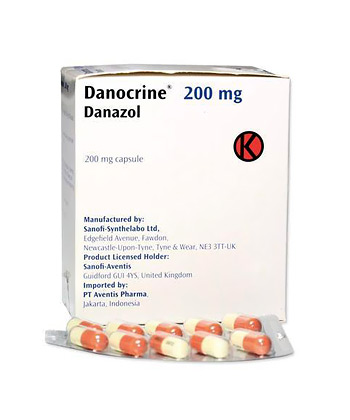
Looking at the box, what should patients expect to see?
The active ingredient is danazol, and the ATC code is G03XA01.
Brand naming can vary by supplier, but the ingredient stays the same across branded and generic packs.
UK patients may see Danol or Danocrine depending on procurement and current stock.
| Brand | Strengths | Supplier |
|---|---|---|
| Danocrine | 50 mg, 100 mg, 200 mg | Sanofi, others |
| Danol | 100 mg, 200 mg | Aspen Pharmacare, Teva UK |
| Cyclomen | 50 mg, 100 mg | Pfizer, Searle |
Depending on pharmacy stock, patients may receive a branded pack or a generic equivalent, but the medicine remains danazol capsules.
Contraindications, High-Risk Groups, And Daily-Life Precautions
Who should not take danazol, or needs extra caution?
- Do not use in pregnancy, because of teratogenic risk.
- Avoid in breastfeeding.
- Do not use in severe hepatic impairment.
- Avoid in porphyria.
- Do not use with active thrombosis or thromboembolic disease.
- Do not use if hypersensitive to danazol or excipients.
People needing close review include older adults, and anyone with hepatic or renal dysfunction, hyperlipidaemia, previous thromboembolic events, hypertension, diabetes mellitus, polycythaemia, or migraine.
In UK counselling, pregnancy prevention matters because danazol is not suitable in pregnancy, and baseline liver assessment is sensible before treatment starts.
Alcohol can add to concern about liver stress, so limiting intake is usually prudent.
Driving advice should be individualised if dizziness, mood change, or headache occurs.
Dosage Guidelines And Adjustments Used In Practice
How much is usually prescribed, and for how long?
| Condition | Starting Dose | Usual Duration | Monitoring Point |
|---|---|---|---|
| Endometriosis | 200 mg/day divided twice daily | 3 to 6 months, rarely up to 9 months | Symptom response and adverse effects |
| Fibrocystic breast disease | 100 to 400 mg/day divided | 4 to 6 months | Breast pain and tolerability |
| Hereditary angioedema | 200 mg/day split twice daily | Ongoing maintenance | Attack frequency and lowest effective dose |
Children are not recommended to use danazol, as safety and efficacy are not established for paediatric use.
In older adults, and in hepatic or renal impairment, dose changes are clinician-directed rather than patient-directed.
Shared decision-making is common in UK practice, especially when symptom relief must be balanced against monitoring and adverse effects.
Lower-dose maintenance may reduce adverse effects when patients are stable on treatment.
Interactions: Medicines, Food, And Monitoring Signals
Which combinations matter most in practice?
The most important interactions to check are warfarin, ciclosporin, and insulin.
That matters in primary care and specialist settings, especially when repeat prescriptions are issued electronically and medicines are changed over time.
Food interactions are less prominent than medicine interactions, but alcohol is best limited because of liver risk.
Tea and coffee do not have a specific known interaction, so there is no need to over-warn unless a clinician has identified a personal issue.
- Warfarin
- Ciclosporin
- Insulin
- Any new anticoagulant
- Any new diabetes medicine
Data highlight: new anticoagulant or diabetes medication changes need review before danazol is continued.
Adverse events can be reported through the MHRA Yellow Card system, which supports monitoring of liver enzymes, mood changes, and androgenic effects.
Cultural Perceptions And Patient Habits In The United Kingdom
Why do patients often ask a pharmacist first?
In the UK, many people want quick reassurance about side effects that affect appearance, mood, work, and relationships.
That is why advice is often sought from pharmacists, NHS 111, and patient forums such as Patient.info or Mumsnet before or alongside formal review.
Boots, LloydsPharmacy, and Superdrug branches are familiar first stops, particularly when a patient wants a straight answer about what to expect.
Online pharmacies are growing, but counselling quality varies, so clear written advice still matters.
- Will the medicine affect my voice or skin?
- Could I gain weight?
- Will my periods change?
- Could it affect my mood or relationships?
- What if I need to work or drive while taking it?
Those questions are reasonable because common side effects include weight gain, acne, oily skin, hirsutism, voice changes, menstrual disturbance, mood change, and breast size decrease.
Availability, Pharmacy Access, And Pricing Across The United Kingdom
Can patients actually get danazol easily in the UK?
Danazol is prescription-only in the UK and may appear as Danol or Danocrine depending on supply.
Access is usually through a GP or specialist prescription, with electronic prescribing used widely across the NHS.
Boots, LloydsPharmacy, Superdrug, and online pharmacies can dispense it when stock is available and the prescription is valid.
In our online pharmacy, danol is available without a prescription, with discreet delivery to United Kingdom in 5-14 days.
Cost depends on whether the prescription is on the NHS or private.
England uses a prescription charge system, while standard NHS prescriptions are generally free in Scotland, Wales, and Northern Ireland.
Private prescription prices can vary significantly, and stock can change, so it is always worth checking with the dispensing pharmacy or NHS provider.
| Region | Access Route | Likely Cost Pattern |
|---|---|---|
| England | GP or specialist prescription | Standard NHS charge or private price |
| Scotland | NHS prescription | Generally free on the NHS |
| Wales | NHS prescription | Generally free on the NHS |
| Northern Ireland | NHS prescription | Generally free on the NHS |
Comparable Medicines And When Alternatives Are Preferred
What if danazol is not the best fit?
Current UK choices often include leuprolide, goserelin, relugolix, elagolix, medroxyprogesterone, and oral contraceptives.
Newer GnRH antagonists may suit some endometriosis patients better because of their tolerability profile, while progestins and contraceptives may suit others depending on symptom pattern and fertility goals.
| Medicine | Typical Role | Why It May Be Preferred |
|---|---|---|
| Leuprolide | Endometriosis alternative | Established GnRH agonist option |
| Goserelin | Endometriosis alternative | Similar pathway and specialist use |
| Relugolix | GnRH antagonist | Oral therapy with different tolerability |
| Elagolix | GnRH antagonist | May suit selected endometriosis patients |
| Medroxyprogesterone | Progestin option | Useful where hormonal suppression is needed |
| Oral contraceptives | Symptom control | May fit patients wanting simpler long-term control |
In the UK, treatment choice often depends on fertility plans, previous response, comorbidities, and local formulary guidance.
Frequently Asked Questions About Danazol
- What is Danol used for in the UK?
- It is used for endometriosis, fibrocystic breast disease, and hereditary angioedema under prescription.
- How long does danazol take to work?
- Some symptom improvement may be seen within weeks, but treatment is usually assessed over months.
- Can I get danazol on the NHS or online?
- It can be prescribed on the NHS, and online pharmacies may dispense it when a valid prescription is supplied.
- What side effects mean I should speak to a clinician?
- Voice changes, mood changes, jaundice, swelling, heavy bruising, or severe headache should be reviewed promptly.
Proper Use, Missed Doses, Storage, And Counselling Points
What should a patient do if a dose is forgotten?
| Situation | What To Do | When To Seek Help |
|---|---|---|
| Missed dose | Take it as soon as remembered, but skip it if the next dose is near | If doses are often missed, speak to a pharmacist or prescriber |
| Overdose | Supportive management is needed | Get immediate medical attention if nausea, vomiting, menstrual disturbance, or androgenic effects occur |
| Storage | Keep at 15 to 30°C, protected from moisture and light, and out of children’s reach | If packs are damaged or damp, ask the pharmacy before use |
Using a repeat prescription reminder, NHS patient portal, or phone alarm can help keep dosing steady.
Regular review is important if symptoms change or side effects begin to build up.
Fertility usually returns within 2 to 3 months after stopping, which is worth discussing early if pregnancy is being planned.
Delivery Across United Kingdom
| City | Region | Delivery time |
|---|---|---|
| London | Greater London | 5 to 7 days |
| Birmingham | West Midlands | 5 to 7 days |
| Manchester | North West England | 5 to 7 days |
| Glasgow | Scotland | 5 to 7 days |
| Liverpool | North West England | 5 to 7 days |
| Leeds | Yorkshire and the Humber | 5 to 7 days |
| Edinburgh | Scotland | 5 to 7 days |
| Bristol | South West England | 5 to 7 days |
| Cardiff | Wales | 5 to 7 days |
| Newcastle upon Tyne | North East England | 5 to 7 days |
| Nottingham | East Midlands | 5 to 9 days |
| Sheffield | Yorkshire and the Humber | 5 to 9 days |
| Leicester | East Midlands | 5 to 9 days |
| Aberdeen | Scotland | 5 to 9 days |
| Portsmouth | South East England | 5 to 9 days |