Erythromycin
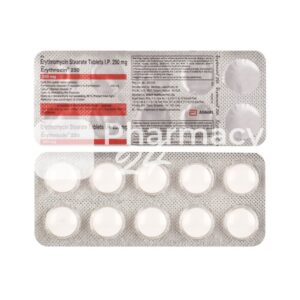
In brief
- In our pharmacy, you can buy erythromycin without a prescription, with delivery available throughout the United Kingdom in discreet packaging. However, in many countries erythromycin is usually prescription-only, so local rules may vary.
- Erythromycin is used to treat bacterial infections such as respiratory, skin and soft-tissue infections, and some eye infections; it is also used topically for acne. It is a macrolide antibiotic that works by inhibiting bacterial protein synthesis by binding to the 50S ribosomal subunit.
- The usual dose of erythromycin depends on the condition and formulation: oral adults commonly take 250–500 mg every 6 hours; children usually receive 30–50 mg/kg/day in divided doses. Topical acne treatment is typically 2% applied twice daily, and eye ointment is used as directed.
- The form of administration includes oral tablets, delayed-release tablets, oral suspension, topical solution or gel, eye ointment, and powder for suspension.
- The effect of erythromycin usually begins within 1–2 hours after an oral dose, although the exact onset depends on the formulation and the infection being treated.
- The duration of action is typically around 6 hours for standard oral dosing, which is why it is often taken four times daily. Treatment courses for infections are commonly 7–14 days, while topical use may continue longer until improvement.
- Avoid or limit alcohol, as it may worsen stomach upset, nausea, and diarrhoea, which are already common with erythromycin.
- The most common side effects are nausea, vomiting, abdominal cramps, diarrhoea, and sometimes rash or local irritation with topical use.
- Would you like to try erythromycin without a prescription?
Basic Erythromycin Information
- INN (International Nonproprietary Name): Erythromycin
- Brand names available in United Kingdom: Generic erythromycin is more common in UK supply, while patients may also see Ilosone, E.E.S. 400, Akne-Mycin, Ery, Macin, Mitrocin, Makcin and Mycin in international pack information.
- ATC Code: J01FA01
- Forms & dosages: Oral tablets 250 mg, 500 mg and 400 mg; oral suspensions 125 mg/5 ml and 250 mg/5 ml; delayed-release tablets 250 mg and 400 mg; topical solution or gel 2%; eye ointment 5 mg/g; powder for suspension 125 or 250 mg/5 ml.
- Manufacturers in United Kingdom: UK patients may receive products supplied through international manufacturers and distributors such as Alembic Pharmaceuticals, Polfa Tarchomin, Anuh Pharma Ltd, Anhui Sinotech, Tenatra, DKSH, Millat Pharmaceuticals, Hallmark Pharmaceuticals and Azurity Pharmaceuticals.
- Registration status in United Kingdom: Prescription only in most jurisdictions, with systemic over-the-counter supply not generally available.
- OTC / Rx classification: Prescription only.
Latest UK And EU Research On Erythromycin
What does the latest UK and EU evidence say about erythromycin antibiotic use today?
The short answer is that erythromycin still has a place, but it is now used more selectively because stewardship guidance pushes prescribers towards the narrowest effective option.
In primary care, NHS clinicians still consider erythromycin tablets when a macrolide antibiotic is needed for a susceptible infection, especially where penicillin allergy limits choices or local resistance patterns support its use.
Safety surveillance continues to focus on the same themes that matter in day-to-day practice: gastrointestinal tolerability, QT prolongation risk, hepatic effects and a high burden of drug interactions.
| Finding | Clinical Meaning | UK/EU Relevance | Evidence Source Type |
|---|---|---|---|
| Gastrointestinal adverse effects remain common | People may stop early because of nausea, vomiting or diarrhoea | Affects adherence in NHS prescribing | Pharmacovigilance and comparative safety data |
| QT prolongation risk is well recognised | Extra caution is needed in heart rhythm disorders and with QT-prolonging medicines | Reflected in MHRA-style safety messaging and pharmacy screening | Regulatory safety surveillance |
| Hepatic effects can occur | Dose review is sensible in liver impairment and after previous cholestatic jaundice | Important in older adults and repeat prescribing | Post-marketing reports |
| Interaction burden is high | CYP3A4 interactions can change exposure to many medicines | Community pharmacists often intervene before supply | Clinical pharmacology and medicines-safety reviews |
Comparative studies also show that erythromycin can be less convenient than azithromycin or clarithromycin, mainly because of dosing frequency and tolerability.
That older evidence base still matters in UK primary care, because many long-used prescriptions are supported by practical experience as well as trial data.
Clinical Effectiveness In NHS Practice
Is erythromycin effective enough for NHS treatment when there are newer macrolides on the shelf?
It can be, provided the bacteria are susceptible and the diagnosis is right.
In NHS practice, erythromycin for infection is used for selected respiratory infections, some skin and soft-tissue infections, and occasional topical or ophthalmic indications.
Effectiveness is driven by local resistance patterns, adherence and the right duration, not by assumptions that a “stronger” antibiotic is automatically better.
Many patients notice improvement after a few days, but the course still needs to be completed unless a clinician says otherwise.
Common reasons for switching or avoiding erythromycin 250mg:
- Stomach upset that makes adherence difficult.
- Known or suspected interaction with another medicine.
- A better-tolerated macrolide being suitable for the same infection.
- Local antimicrobial guidance favouring another option.
When erythromycin is useful, it is usually because the patient needs a macrolide antibiotic, cannot take penicillin, or is using a topical form for acne or eye infection.
Electronic prescribing and the pharmacist’s check matter here, because a quick interaction review can prevent avoidable harm before the medicine leaves the pharmacy.
Indications And Expanded Uses
Which problems does erythromycin actually treat in UK-friendly terms?
For most people, the search starts with erythromycin tablets, erythromycin ointment or erythromycin oral suspension, but the indication is what should drive the choice.
- Respiratory infection
- Common oral form: 250 mg or 500 mg tablets, or suspension for children.
- Typical setting: NHS primary care when a macrolide is needed and the organism is likely susceptible.
- Skin and soft-tissue infection
- Common oral form: tablets or suspension, with topical use in some skin conditions.
- Typical setting: Community prescribing after clinical assessment of the rash, lesion or wound.
- Acne
- Common form: topical 2% solution or gel.
- Typical setting: Longer-term dermatology or GP-directed treatment.
- Bacterial eye infection
- Common form: eye ointment 5 mg/g.
- Typical setting: Ophthalmic use when a clinician advises it.
Oral tablets are available as 250 mg, 500 mg and 400 mg strengths, while oral suspensions come as 125 mg/5 ml and 250 mg/5 ml.
An expanded use sometimes discussed in specialist care is prokinetic treatment for gastroparesis, although this is not the common NHS front-line role.
Erythromycin is prescription only in most jurisdictions, so it should always be used according to the prescriber’s instructions.
Composition, Brands And UK Formulation Landscape
Why do the packs look different from one country to another?
Erythromycin is an old, widely manufactured macrolide antibiotic, so brand names vary by market even though the active ingredient stays the same.
| Brand | Formulation | Pack Size | Likely UK Relevance |
|---|---|---|---|
| Ilosone | Tablets or suspension | Varies | May appear in international reference material |
| E.E.S. 400 | Film-coated tablet | 400 mg | Seen mainly in overseas sourcing |
| Akne-Mycin | Topical ointment | 20 mg/g | Relevant to acne searches and topical comparison |
| Ery | Eye ointment | 5 mg/g | Useful reference for ophthalmic supply |
| Macin, Mitrocin, Makcin, Mycin | Tablets or powder for suspension | 125 mg/5 ml, 250 mg/5 ml, 250 mg, 500 mg | International packaging variation |
Manufacturers and suppliers include Azurity Pharmaceuticals, Alembic Pharmaceuticals, Polfa Tarchomin, Anuh Pharma Ltd, Anhui Sinotech, DKSH, Millat Pharmaceuticals and Hallmark Pharmaceuticals.
That supply chain matters because UK patients may see generics more often than branded packs, and the label may differ across the UK, EU and other markets.
The safest habit is to check the active ingredient rather than assume that a familiar brand always means the same formulation.
Contraindications And Special Precautions
Who should not take erythromycin, and when does a pharmacist have to pause the supply?
The main problems are allergy, heart rhythm risk and previous liver injury linked to erythromycin.
- Do not use if there is known macrolide allergy, including erythromycin.
- Do not use with medicines that significantly prolong QT interval or are contraindicated because of CYP3A4 metabolism.
- Do not use if there was cholestatic jaundice or hepatic dysfunction with previous erythromycin use.
- Use with caution in hepatic impairment, myasthenia gravis, arrhythmias or prolonged QT interval.
| Situation | Practical Advice |
|---|---|
| Heart medicines or antiarrhythmics | Tell the pharmacist, because interactions may be serious. |
| Antidepressants or other QT-prolonging drugs | Check before starting, especially if there is a history of palpitations. |
| Liver disease | Discuss benefit and dose adjustment with the prescriber. |
| Pregnancy or breastfeeding | Needs clinician-led benefit-risk assessment rather than blanket avoidance. |
Driving is usually fine unless dizziness or visual changes affect you.
Alcohol is not a classic direct interaction, but it can make stomach upset worse and is best avoided if liver disease is present.
If breathing problems, widespread rash, swelling, fainting or marked palpitations occur, urgent medical help is needed.
Dosage Guidelines And NHS-Style Use
How much erythromycin should be taken, and for how long?
The answer depends on age, weight, infection type and the form prescribed.
| Group | Typical Dose | Usual Duration |
|---|---|---|
| Adults, respiratory infection | 250–500 mg every 6 hours orally | 7–14 days |
| Adults, skin or soft-tissue infection | 250–500 mg every 6 hours orally | 7–10 days |
| Children | 30–50 mg/kg/day in 2–4 doses | 7–14 days, or as directed |
| Topical acne | Apply 2% solution or gel twice daily | Until improvement |
| Eye ointment | Apply in the affected eye(s) every 6 hours | Typically 7–14 days |
Children should use suspensions and dosing by weight, while elderly patients may need closer hepatic monitoring.
Liver impairment often means a reduced dose or longer interval, because erythromycin is metabolised in the liver.
Renal adjustment is usually not needed unless impairment is severe.
- If a dose is missed, take it when remembered unless the next dose is nearly due.
- Do not double up.
- If vomiting, fainting or hearing changes occur, seek urgent medical advice.
- In overdose, medical attention is needed straight away.
Interactions With Food, Drink And Medicines
Why do pharmacists ask about so many other medicines with erythromycin?
Because the interaction burden is one of the biggest reasons this macrolide antibiotic needs careful checking.
| Interaction Type | Examples | What Patients Should Do |
|---|---|---|
| CYP3A4 medicine interactions | Statins, some calcium-channel blockers, benzodiazepines and other macrolides | Tell the pharmacist about every prescription and non-prescription medicine. |
| QT prolongation risk | Antiarrhythmics and other QT-prolonging medicines | Do not start without a professional check. |
| Warfarin interaction risk | Blood-thinning treatment | Clinicians may monitor more closely. |
| Food and drink | Alcohol, tea, coffee, meals | Alcohol may worsen stomach upset; food can help tolerability depending on the label. |
Tea and coffee are not major direct interactions.
For practical counselling, the pharmacist is often the final safety check in community pharmacy or online supply.
Where side effects or suspected interactions are reported, NHS teams may also use Yellow Card reporting.
Cultural Perceptions And Patient Habits In The United Kingdom
What do UK patients usually worry about when they are handed erythromycin?
Most concerns are very down to earth: tummy upset, whether the course is too long, and whether something “stronger” would work better.
That is why people often ask on NHS 111, through the NHS App, or in forums such as Patient.info and Mumsnet before they speak to the prescriber.
Those discussions usually highlight a few common habits.
- Choosing the easiest dosing schedule, especially if work or childcare is busy.
- Wanting reassurance that an older antibiotic is still worthwhile.
- Looking for quick digital advice before a pharmacy visit.
- Preferring click-and-collect or online pharmacy services, but still wanting clear counselling.
- “Is this a stronger antibiotic?”
- What people usually mean is whether it will work faster or feel more effective.
- “Will it upset my stomach?”
- That is one of the commonest real-world concerns with erythromycin.
- “Why did the pharmacist check all my medicines?”
- Because interaction checks are essential with this drug.
Erythromycin may feel older than azithromycin or clarithromycin, but older does not mean obsolete.
It simply means the medicine has a long, well-understood role where the right patient and the right indication still matter.
Availability And Pricing Patterns Across The United Kingdom
How can people in the UK get erythromycin, and what does it usually cost?
Access is through the NHS, private prescribing or online pharmacy supply, depending on the situation.
| Access Route | Likely Cost Pattern | Availability Notes | Patient Action |
|---|---|---|---|
| NHS prescription | England usually has the standard prescription charge; Scotland, Wales and Northern Ireland generally do not charge | Availability depends on local stock and formulation | Ask the prescriber or pharmacist if the exact form is available |
| Private prescription | Price varies by formulation, pack size and brand | Often easier for specific formulations | Compare pack details and confirm the active ingredient |
| Online pharmacy | Depends on the service and delivery option | Systemic OTC supply is not generally available | Use a regulated provider and complete the medicine questionnaire carefully |
Boots, LloydsPharmacy and Superdrug are familiar UK access points, although actual stock varies by branch and by formulation.
In our online pharmacy, erythromycin is available without a prescription, with discreet delivery to United Kingdom in 5-14 days.
For people searching “erythromycin price” or “erythromycin tablets UK”, the key point is that access and pricing differ by route, strength and pack type.
Comparable Medicines And Why Prescribers May Choose Alternatives
Why do prescribers sometimes choose azithromycin or clarithromycin instead?
Usually because the course is shorter, the dosing is easier and the tolerability profile may be better.
| Medicine | Dosing Frequency | GI Tolerability | Interaction Burden | Typical NHS Use |
|---|---|---|---|---|
| Erythromycin | Often every 6 hours | More nausea and abdominal upset in practice | High | Selected infections, topical acne, eye use |
| Azithromycin | Usually simpler | Often better tolerated | Lower than erythromycin in many situations | Frequently chosen when suitable |
| Clarithromycin | Usually simpler than erythromycin | Often better tolerated | Still significant | Common macrolide alternative |
That said, erythromycin remains useful when the formulation suits the patient, the infection pattern fits, or the clinician prefers a familiar older option.
Local antimicrobial formularies and stewardship rules usually matter more than a patient’s preference for one brand, whether that is Erythrocin, Erymax, Erythroped, Erythroped A, Tiloryth, Primacine or Aknemycin Plus.
The best antibiotic is the one that matches the diagnosis, resistance pattern and safety profile.
Common Questions About Erythromycin
- How long does erythromycin take to work?
- Symptoms often begin to improve within a few days, but the full course should be completed.
- Can I take it with food?
- That depends on the formulation and label advice, but food may help if stomach upset is a problem.
- What if I miss a dose?
- Take it as soon as remembered unless the next dose is nearly due, and never double the dose.
- Why did my pharmacist ask about other medicines?
- Because erythromycin interactions can be clinically important, especially with heart medicines and statins.
Severe side effects, rash, breathing difficulty, palpitations or collapse need urgent medical advice.
Proper Use, Storage And NHS Support
How should erythromycin be taken so it works properly and stays safe?
- Take it exactly as prescribed.
- Finish the course unless the prescriber says otherwise.
- Tell the prescriber about heart medicines, liver disease and previous antibiotic reactions.
- Check the label carefully, because tablets, suspensions, topical forms and eye ointments are not interchangeable.
- Use pharmacist advice, NHS 111, GP review and official NHS guidance if symptoms worsen.
| Form | Storage Advice |
|---|---|
| Tablets or capsules | Store below 25°C and protect from moisture. |
| Suspensions | Store as directed after reconstitution, shake before use and follow the label. |
| Topicals | Keep at room temperature and avoid freezing. |
| Eye ointment | Store below 25°C and discard after the course. |
Electronic prescriptions and NHS patient portals make repeat access easier, but they do not replace counselling.
Because erythromycin has a broad interaction profile, online supply still needs careful checking of diagnosis and other medicines before it is sent out.
Delivery Across United Kingdom
| City | Region | Delivery time |
|---|---|---|
| London | England | 5-7 days |
| Birmingham | England | 5-7 days |
| Manchester | England | 5-7 days |
| Leeds | England | 5-7 days |
| Liverpool | England | 5-7 days |
| Glasgow | Scotland | 5-7 days |
| Edinburgh | Scotland | 5-7 days |
| Cardiff | Wales | 5-7 days |
| Belfast | Northern Ireland | 5-7 days |
| Sheffield | England | 5-9 days |
| Bristol | England | 5-9 days |
| Leicester | England | 5-9 days |
| Aberdeen | Scotland | 5-9 days |
| Newcastle upon Tyne | England | 5-9 days |
Erythromycin remains a useful macrolide antibiotic when the indication is right and the safety check is done properly.
For UK patients, the most important steps are still simple: confirm the form, check the interaction list, follow the dose, and seek help early if side effects appear.